
News
10 min read
Before Dune
Part Three: What We’ll See From Dune Messiah and Why Frank Herbert Wrote It as a Warning
Link copied
Warning: this article contains major spoilers for Dune Messiah and potential plot elements from Dune: Part Three.
By the end of Dune: Part Two, Paul Atreides has gained almost everything the story has been leading him toward. The Harkonnens have been defeated, the Emperor has been overthrown, and the Fremen have accepted him as their messiah. Paul takes the throne and sends his armies against the Great Houses that refuse to recognize his rule. If this were a conventional heroic story, this would probably be the moment for triumphant music.
But Frank Herbert never wanted Paul to be seen simply as a hero. And that is precisely why he wrote Dune Messiah. Denis Villeneuve will conclude his film trilogy with Dune: Part Three, based on Herbert’s second novel. The director himself has described Dune Messiah as his favorite book in the series and the third film as the most personal movie he has made so far.
For viewers who know Dune only through the films, however, one important change is coming. This is no longer the story of Paul Atreides’ rise. It is the story of the consequences of his victory.
Dune Was Never Quite as Heroic a Story as It Appears
Paul is an extremely easy character to root for. His family is betrayed, his father is killed, and House Atreides is effectively destroyed. He and his mother flee into the desert, find refuge among the oppressed Fremen, and Paul gradually becomes the man capable of leading them against their oppressors. It sounds almost like the perfect story of a chosen savior. And that is exactly the trap.
Herbert repeatedly explained that one of the central ideas behind Dune was the danger of blindly following charismatic leaders. He even said that figures like these should come with a warning label: “May be dangerous to your health.”
In another interview, he framed the question even more directly: why do we follow charismatic leaders without questioning them? In Herbert’s view, a leader’s mistakes are multiplied many times over when vast numbers of people carry them out without question.
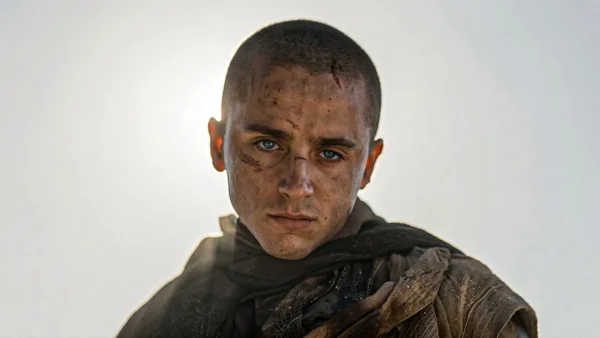
What is particularly interesting is that Timothée Chalamet offers almost exactly the same reading of the story. While discussing the third film, he explained that, as he understands it, Herbert wrote Dune Messiah because some readers had interpreted Paul as a conventional hero, and the author wanted to make the warning much clearer – to show what can happen when people begin following their leaders blindly.
Paul Atreides is the experiment. Herbert first makes us want him to win. Then he shows us what that victory actually means.
Dune Messiah Begins When the Legend Has Already Become a State
The novel takes place 12 years after the victory over the Harkonnens. Paul is no longer the young exile in the desert. He is Emperor of the known universe. The Fremen do not merely follow him – they worship him. And the religious war fought in his name has spread across the galaxy and caused the deaths of billions.
The official description of the novel emphasizes precisely this paradox: Paul possesses more power than any one person should have, yet he still proves incapable of stopping the war unleashed by his own legend. That is the crucial shift. In the first story, the question is: Will Paul succeed in taking power? In the second: What do you do once you already have it? And, more uncomfortably: Is there a point at which even the messiah can no longer control the religion built around him?
The Film Goes Even Further Into the Future
Villeneuve changes one of the novel’s basic parameters. Instead of taking place 12 years after the previous story, the new film will be set 17 years later. That means we will encounter a world that has lived for almost two decades under the rule of Paul Atreides. Villeneuve himself describes Paul as a man trying to escape the cycle of violence created by his own power, while forces are already organizing against him.
This also allows Villeneuve to use the adult Alia we have already seen, played by Anya Taylor-Joy. But the bigger change has nothing to do with age. Her name is Chani.
The Chani of the Films and the Chani of the Book Are Now Two Different Characters
At the end of Dune: Part Two, Chani watches Paul embrace the role he had previously resisted. He uses the prophecy, accepts power, proposes marriage to Princess Irulan and Chani leaves. That does not happen this way in the novel. In the book, Paul’s marriage to Irulan is also political, but Chani remains his true partner. Irulan has the title, but she does not have Paul’s love or intimacy.
That difference is enormous because, in Dune Messiah, the relationship between Chani, Paul, and Irulan is a central part of the political conspiracy. Villeneuve has already rearranged the pieces. Now he has to bring them together again.
Timothée Chalamet, who plays Paul, has even acknowledged that the third film weaves in storylines that are not explicitly present in the book, and that this may be the point at which Villeneuve takes his greatest creative liberties so far.
Here I will allow myself one very personal comment as a Herbert reader. Splitting the first novel into two films disappointed some fans, myself included, largely because there were moments when I felt that the visual effects and spectacle were given priority over the development of the story itself. That is especially true of the first film, while the second still struggles with that balance to some extent. That is precisely why Dune Messiah feels like such an interesting challenge for Villeneuve. This is a much more inward-looking story, where political conspiracy, Paul’s prescience, and the sense of inevitability matter more than yet another spectacular battle.
And Irulan Will No Longer Be Just a Political Figure in the Background
Florence Pugh has comparatively little screen time in the first two films. That is going to change. In Dune Messiah, Irulan is far more important. She is Paul’s wife in title, the daughter of the deposed Emperor, and a woman caught in a strange position between her own ambitions, the Bene Gesserit, and the Atreides dynasty.
Most importantly, she takes part in a conspiracy against her own husband. And she is not alone. A coalition gradually forms against Paul, made up of forces with very different reasons for wanting his regime to end. At this point, the story begins to resemble a military epic far less and a political thriller far more.
It is no coincidence that Villeneuve has said that if the first film was contemplative and the second a war movie, the third is more dynamic and more tense. He has also described it as “more of a thriller”, more intense and more emotional than the previous installments.
And One Dead Character Is Coming Back
Duncan Idaho returns. Yes, the same Duncan who died in the first film. Just not quite. He returns as a ghola – a recreated body of the dead Duncan, produced by the Tleilaxu and sent to Paul. Jason Momoa is officially part of Dune: Part Three, and the footage shown so far confirms that his return will be one of the film’s major elements. And once again, Herbert does something far more interesting than simply “bringing back a beloved character.”
Duncan becomes a question. If the body is the same but the memories are gone, is this still the same person? And what if those memories can be restored? Where, then, does identity begin and end?
Scytale and the Conspiracy Against an Almost Unbeatable Emperor
The major new name in the cast is Robert Pattinson as Scytale. In the novel, he is a Tleilaxu and part of the conspiracy against Paul. In the film, the character will again be associated with the ability to change his appearance, while the trailer already places him openly among the Emperor’s main opponents.
But the interesting thing is that Paul is not an ordinary ruler against whom you can simply organize a coup. He can see the future. And that is where one of the great paradoxes of Dune Messiah emerges. If you know what is going to happen, are you free to change it? Or does knowledge of the future turn you into its prisoner? Paul has reached an almost godlike level of power? But the more he sees, the less free he appears to become.
The Scene I’m Most Excited to See
Of all the complicated ideas in the novel, there is one scene I most want to see Villeneuve translate into cinematic language. The unraveling of the conspiracy and the arrival of the twins. Paul is already physically blind, while his prescient vision is also beginning to break down. Then he discovers that his children are not ordinary newborns. Particularly strange is his connection with his son Leto, through whose eyes Paul is briefly able, quite literally, to see. It is this connection that allows him to confront Scytale.
For me, this may also prove to be Timothée Chalamet’s most difficult acting challenge in the entire trilogy. To play a man who can see the future, but is not made freer by that knowledge. Quite the opposite. Paul knows what is coming, and yet he seems incapable of escaping his own prophecy. On the page, Herbert can take us directly inside that logic. On screen, Chalamet has to make it visible through a man who simultaneously knows too much and is able to change too little. That interests me far more than the next spectacular battle.
The Third Dune Will Not Ask Whether Paul Can Win
He already has. And that is exactly the problem. When Dune: Part Three is released on December 18, 2026, we will not be watching a young heir trying to reclaim his home. We will be watching an Emperor, а messiah, а man in whose name billions have died, а man capable of seeing the future and yet seemingly unable simply to step outside it.
And a leader who gradually discovers that absolute power does not mean absolute control. Perhaps that is why Dune Messiah is such a necessary second half of the story. Dune makes us want Paul to win. Dune Messiah asks us why we wanted it so badly.
Стани част от общността
Твоята библиотека започва тук
Всяка книга оставя следа.
Създай профил и превърни прочетеното в твоя лична библиотека.
Последвайте ни в социалните мрежи:
What do you think?
Share your view with the Booklovers community.

No comments yet. Be the first.