The Steps, Sylvester Stallone
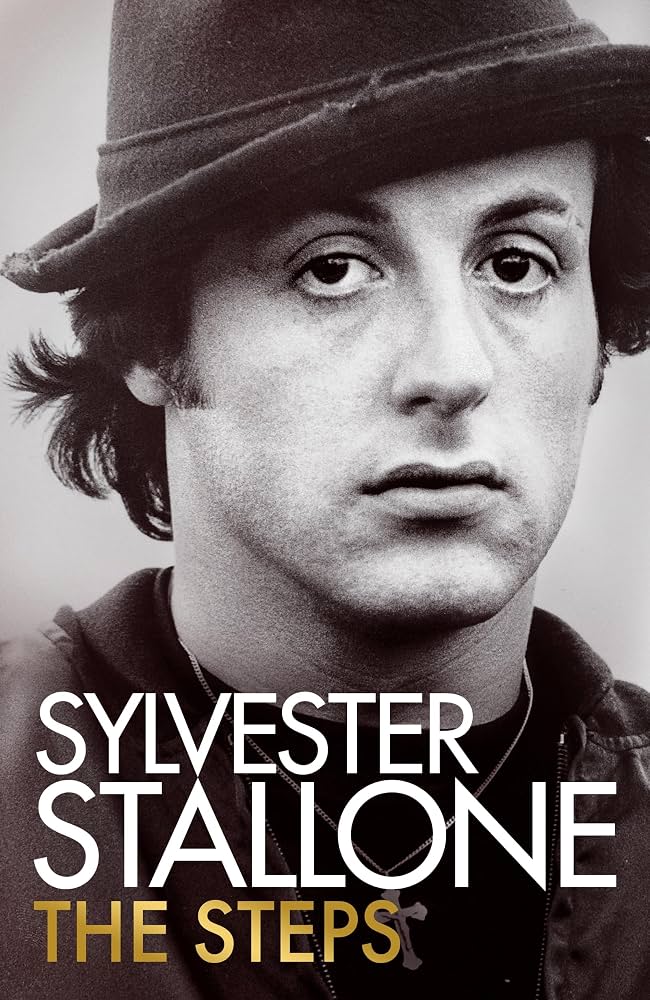
Fifty years after Rocky ran up the steps of the Philadelphia Museum of Art, Sylvester Stallone returns to them in his autobiography, The Steps – but this time, not to tell the story of a fictional boxer, but his own.
The main narrative follows the years between Stallone’s arrival in New York in 1969 and the night in 1977 when Rocky won the Academy Award for Best Picture. But the story also reaches back into his childhood and explores the price that came with success.
“The world isn’t all sunshine and smiles. It is a mean and nasty place, and I don’t care how tough you are, it will knock you to your knees and keep you there forever if you let it. Neither you, nor me, nor anyone or anything in this world hits as hard as life. But it isn’t about how hard you hit. It’s about how hard you can get hit and keep moving forward – how much you can take without stopping. That’s how winning is done.”
Rocky Balboa’s speech from Rocky Balboa is perhaps one of the most recognizable summaries of the philosophy Stallone built around his most famous character.
Before Rocky
Sylvester Gardenzio Stallone was born on July 6, 1946, in New York, and life presented him with its first challenge from the moment he entered the world. Damage to a facial nerve caused by the use of forceps during his birth resulted in the characteristic asymmetry of the lower part of his face and his distinctive speech – traits that would later become almost inseparable from his public image.
As a child, however, they made him a target for ridicule. His parents, Frank and Jackie Stallone, had a turbulent marriage that ended in divorce while Sylvester was still young. His school years hardly suggested the beginning of a future Hollywood career either. He struggled with behavioral problems, constantly felt different, and had few people around him who saw much potential in him.
“They told me I would never amount to anything in life, but instead of believing them, it gave me even more motivation,” he has said. These years matter in The Steps because Stallone does not present success as the sudden discovery of some hidden talent. Instead, it emerges from a long series of rejections.
New York, 1969: A Dream and Almost No Money
When Stallone arrived in New York in 1969, he wanted to become an actor, but reality was a long way from Hollywood. Despite the difficulties, he dreamed of performing under the spotlight. After studying acting in Miami and New York, he began going to auditions and took whatever work he could find. Among his more unusual jobs was cleaning lion cages at the Central Park Zoo.
His first paid role came in the low-budget erotic film The Party at Kitty and Stud’s (1970), later re-released as The Italian Stallion. Stallone has said that he accepted the part because he had run out of money and had no way to support himself.
“I was desperate. I had two choices – either do the film or rob someone.” Six years later, Stallone achieved the dream he had been chasing since childhood.
In 1975, he watched a boxing match between Muhammad Ali and underdog Chuck Wepner. Inspired by Wepner’s determination to survive 15 rounds against the legendary Ali, Stallone wrote the screenplay for what would become Rocky in just three days.
He pitched the story to several producers, who liked the screenplay but did not want Stallone in the lead role. They had bigger names in mind, including Robert Redford or Burt Reynolds.
Stallone refused to make the deal unless he was allowed to play Rocky Balboa himself.
After considerable compromise and with a modest budget of around $1 million, the film was made – and became a huge success with audiences.
Rocky won three Academy Awards, including Best Picture, and Stallone became an international star.
“Rocky is a metaphor for my life. At its core is the idea that you have to keep fighting even when everything is against you,” the actor has said.
His mastiff Butkus, who also appeared in the first Rocky film, had been Stallone’s loyal companion during the difficult years before fame. Living in poverty and unable to afford to feed him, Stallone sold Butkus for $50. After his fortunes changed, however, he bought the dog back for $3,000.
Why The Steps?
The title is an obvious reference to the legendary scene. But in the book, the steps are also a metaphor. There is no single enormous leap between the boy who was told he would never amount to anything and the world-famous Sylvester Stallone. There are small roles. Bad jobs. Rejections. Financial failures. Scripts nobody wants. Decisions that seem irrational. And then one more step.
The official description of the memoir presents it as a book about “the distances we are willing to travel and the steps we must take to get from where we are to where we want to be.” That is also why the main narrative ends in 1977 – not because Stallone’s career ends there, but because this is the point where the story of the underdog ends and the story of the star begins.
After Rocky Came Rambo, The Expendables and a Second Career
Following his breakthrough, Stallone went on to create some of the most recognizable characters in popular cinema. Rocky received numerous sequels, and in 1982 Stallone took on the role of Vietnam War veteran John Rambo in First Blood. Initially a much darker character, scarred by war and post-traumatic stress, Rambo gradually evolved into one of the defining action icons of the 1980s.
Decades later, Stallone brought together an entire generation of action stars in The Expendables, while Bulgaria became one of the franchise’s regular filming locations. In 2022, he also made a surprisingly successful debut as the lead of a television series.
In Tulsa King, Stallone plays Dwight Manfredi, a New York mobster who is sent to Oklahoma after serving 25 years in prison and tasked with building a new criminal operation.
But The Steps is not an encyclopedia of all these successes. Its focus remains on the moment before them. This is a story that does not begin at the top, but with a man still standing at the bottom, trying to decide whether he has enough strength left to climb the next step.
Join the community
Your library starts here
Every book leaves a mark.
Create your profile and turn what you read into your personal library.
Follow us on social media: