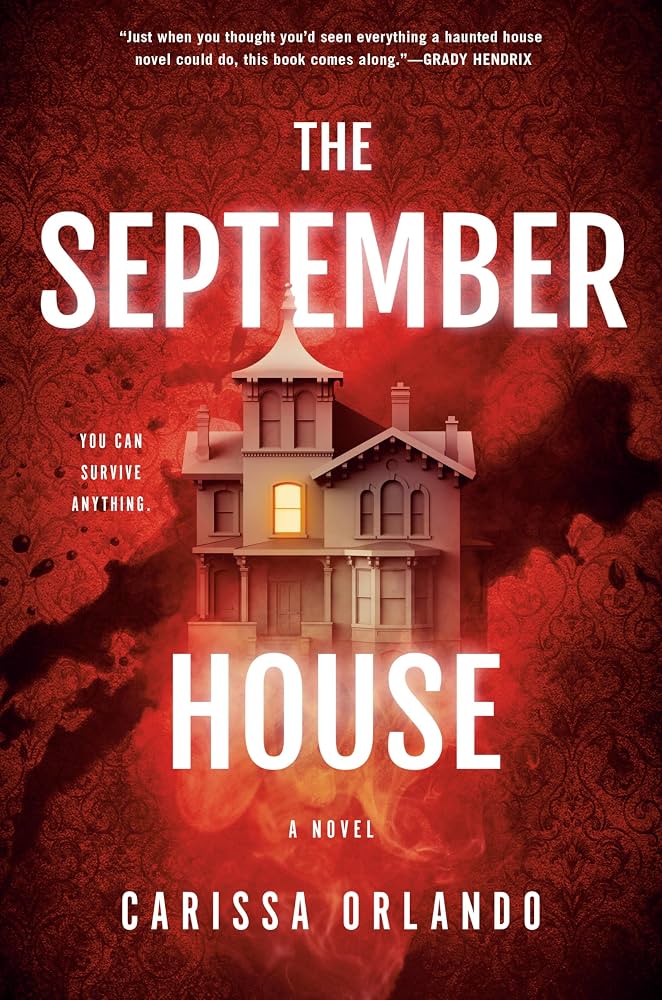
What would you do if you finally found your dream home – a beautiful Victorian house with a spacious porch, an enormous garden, authentic furniture, and gorgeous vintage wallpaper – only to discover shortly after moving in that the place is haunted? You would probably run. Margaret is not like most people.
In her debut novel, The September House, Carissa Orlando takes one of horror’s most familiar tropes – the haunted house – and changes its most basic rule. Her protagonist, Margaret, does not gradually discover that something supernatural is happening in her home. She already knows. She knows about the ghosts, the midnight screams, and the fact that every September the walls begin to bleed. She even knows that something lives in the basement and is probably best left alone. And despite all of it, she has absolutely no intention of leaving her home.
The Dream House Has One Tiny Flaw
When Margaret and her husband Hal buy the imposing cobalt-blue Victorian house on Hawthorn Street, they can hardly believe their luck. At last, they have a home of their own. They soon discover, however, that they are not its only residents. Every September, the house changes. The ghosts of its former inhabitants appear in the hallways. Screams and moans echo through the rooms at night. Blood begins to run down the walls.
Carissa Orlando herself explains:
“Margaret is determined to live peacefully with her formerly-living roommates—pranksters, as she calls them—and has developed a set of rules for surviving in her house of horrors. She has no intentions of fighting back, even when the paranormal events worsen each September, and definitely not against the creature who lives in the basement. Then Margaret’s husband, Hal, vanishes. Their estranged daughter, Katherine, insists on coming to visit to look for Hal, unaware that the house is haunted. Margaret’s priority is to keep Katherine safe, a difficult task with September starting. As Katherine’s search for her father turns up distressing findings, Margaret is at a loss on how to protect her daughter not only from the pranksters in the now but from the past she so desperately wanted to keep in the then.”
And yes, the ghosts are definitely not the only thing haunting this family.
Why Would Anyone Stay in a House Where the Walls Bleed?
That may be the most interesting question in the entire novel. Not: Are there ghosts? But: Why doesn’t Margaret simply leave?
Carissa Orlando holds a doctorate in psychology and has spent more than a decade studying and working in the field. In her professional life, she works as a clinical psychologist, including with children and young people.
That experience inevitably shapes the way she creates her characters.
“One of the many, many lessons I’ve taken from my career is that every person’s actions, no matter how perplexing they are at face value, are completely understandable once you learn a bit about the person and their context. I feel that I took that lesson into the characters in this novel – Margaret definitely engages in a lot of behaviors that readers might not choose for themselves (electing to stay in a house full of ghosts, for example). However, this all makes perfect sense for Margaret and who she is as a person.”
“I Just Love Haunted House Stories”
Orlando makes no secret of her love for horror. And especially houses with an inconveniently active afterlife. When asked what exactly attracts her to such a familiar trope, her answer could hardly be more enthusiastic:
“I’m not even sure I can fully articulate what it is about them, but I just love haunted house stories. I love them. I love all the tropes – the screaming and the bleeding and the formerly-living residents and the monsters in the basement and the immense metaphoric potential. I love a good metaphoric potential. Also, there is something so fantastically lovely about ghosties and goblins coming to get us in the place where we live and eat and sleep, the place where our family is, the place where we’re supposed to be the safest of all. The fright in that is so universal, and it makes my twisted little heart deliriously happy.”
But the almost comic accumulation of horror clichés has a very different effect when the one person who categorically refuses to be impressed by any of them is the woman who owns the house. That is where the dark humor comes in. Margaret does not spend the novel screaming and trying to escape. She has already accepted the terms of coexistence with the dead. Almost like particularly annoying neighbors.
A Debut Written During the Pandemic
The September House is Carissa Orlando’s debut novel. The journey from manuscript to bookstore shelves proved considerably longer and more complicated than the people around her initially expected. Orlando sold the novel in late 2021, but the book was not published until nearly two years later.
Join the community
Your library starts here
Every book leaves a mark.
Create your profile and turn what you read into your personal library.
Follow us on social media: