
Article
Historical · 7 min read
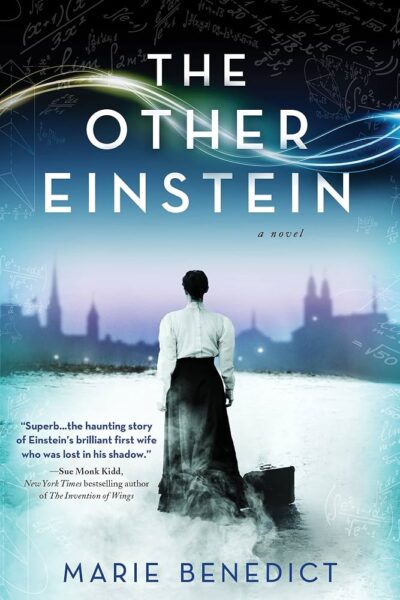
The Other Einstein
Marie Benedict
Marie Benedict chooses the more dramatic version. Mileva does not simply discuss physics with Albert. She participates in his work. In the novel’s interpretation, her contribution extends to the ideas behind the special theory of relativity, while the recognition gradually remains with her husband alone.
Link copied
In The Other Einstein, Marie Benedict takes us to Switzerland in 1896, when a young woman from what was then Austria-Hungary arrives at the Zurich Polytechnic, determined to study mathematics and physics at a time when even completing secondary education remained out of reach for a large proportion of women in Europe.
Her name is Mileva Marić. She is the only woman in her class. Among the other students is Albert Einstein, four years her junior. The two begin as friends, then become lovers, marry, and start a family, while their years together coincide with the period in which Einstein lays the foundations for the work that will transform modern physics.
ETH Zurich confirms that Marić was the only woman enrolled in his course of study in 1896. But what was her role in that story? The genius’s wife? His intellectual partner? An uncredited co-author? Or a woman whose genuinely remarkable life has gradually become surrounded by claims that the historical evidence cannot fully support?
The Woman Who Almost Disappears From Einstein’s Story
The idea for the novel came about in an unexpected way. Marie Benedict was helping one of her sons with a school project, and together they were reading a children’s biography of Albert Einstein. In it, she came across a brief mention that his first wife had also studied physics.
For Benedict, that was enough. “I have always been interested in the hidden voices in history,” she has said. What made the story even more intriguing to her was the historical context surrounding the Einsteins. Mileva was married to Einstein during his famous 1905 annus mirabilis, when he published a series of revolutionary scientific papers. And she herself had received a scientific education at a time when such a path was exceptional for a woman.
Benedict began looking for Mileva in the vast literature surrounding Einstein. And discovered how little space she occupied in it. “The research process for The Other Einstein was surprisingly challenging, given that Mileva Maric was married to one of the world’s most famous men and countless books and articles have been written about him. She does not figure prominently in many of them, so I really relied on the letters to and from her to get a sense of her voice and her internal life.”
Love, Science, and a Career That Never Really Began
The historical foundation of the novel is dramatic enough on its own. Mileva Marić and Albert Einstein studied together in Zurich. A relationship developed between them, and their correspondence reveals their shared interest in science and physics. But their professional paths soon diverged.
Marić failed her final diploma examinations, first in 1900 and then again on her second attempt. In the meantime, she became pregnant. Their daughter Lieserl was born in 1902, but what happened to her afterward has never been conclusively established. Mileva and Albert married in 1903 and later had two sons. Mileva’s scientific career, however, effectively ended. And this is where the central question begins. Did her scientific ideas end there as well?
The Novel Gives a Clear Answer. History Does Not.
In The Other Einstein, Marie Benedict chooses the more dramatic version. Mileva does not simply discuss physics with Albert. She participates in his work. In the novel’s interpretation, her contribution extends to the ideas behind the special theory of relativity, while the recognition gradually remains with her husband alone.
As fiction, this is an extremely powerful construction. As established historical fact, it is far more problematic. Benedict herself does not hide the fact that where the evidence ends, the novelist begins: “I used the research materials and the facts as anchors along the way, and I filled in the gaps in our knowledge with a mixture of logic, research, and fiction. Always, I tried to stay as true as possible.”
In another interview, she is even more direct in acknowledging the considerable artistic freedom she took in shaping Mileva’s story. This is precisely where The Other Einstein becomes particularly interesting as a novel. And particularly risky if it is read as biography.
What Do We Actually Know About Mileva’s Contribution?
Historians have debated the issue for decades. One interpretation sees certain letters as evidence of scientific collaboration. Most often cited is Einstein’s occasional use of phrases such as “our work,” including “our work on relative motion.” Supporters of the collaboration theory see these words as evidence that Mileva actively contributed to the development of the ideas. But this is far from the only possible interpretation.
Historians Allen Esterson and David C. Cassidy examine the surviving evidence in detail in Einstein’s Wife: The Real Story of Mileva Einstein-Marić and conclude that there is no reliable evidence that Marić was an uncredited co-author of Einstein’s famous 1905 papers. An analysis in Physics Today likewise describes the popular idea of Mileva as Einstein’s “secret collaborator” as a claim without sufficiently strong historical foundations. That does not mean there was no intellectual exchange between them, or that she did not read and discuss his work.
But there is a significant difference between that and co-authorship. Esterson’s own research puts the problem even more sharply: claims that Marić co-authored the major papers of 1905 or carried out Einstein’s mathematical work do not withstand close examination of the surviving sources.
The Letters as the Voice of a Woman History Nearly Silenced
For Benedict, the most important source was the correspondence between Mileva and Einstein. “In her own words, I could hear her curious intellect and brilliance as well as her emotional naiveté, and this allowed me to fashion her fictional voice.” That is probably also the greatest strength of historical fiction. It can do something academic biography, by definition, cannot. The problem begins only when the reader stops distinguishing between what is possible and what is proven.
The Other Einstein and the Other Truth
With this book, Marie Benedict began a series of historical novels centered on women left behind more famous names and major historical events. After Mileva Marić came stories connected to Andrew Carnegie, Clementine Churchill, Hedy Lamarr, Agatha Christie, and other women whose roles Benedict has tried to bring out of the historical margins.
And The Other Einstein demonstrates both the strength and the risk of that approach very clearly. Perhaps Mileva Marić deserves to be brought out of Albert Einstein’s shadow without necessarily turning her into the other Einstein. At BOOKLOVERS, we are particularly skeptical and careful when it comes to novels of this kind, because we believe that sometimes the most interesting story is not the one we wish were true, but the one we can prove and everything that remains between the two.
Join the community
Your library starts here
Every book leaves a mark.
Create your profile and turn what you read into your personal library.
Follow us on social media:
Have you read the book?
Rate it and share your thoughts with the Booklovers community.
Readers’ rating
★
★
★
★
★
No ratings yet
Log in to rate this book.


No comments yet. Be the first.