

Review
Fantasy · 6 min read
Gallant
V. E. Schwab
When Atmosphere Is Not Enough
★★★★★
5/5 Booklovers
Link copied
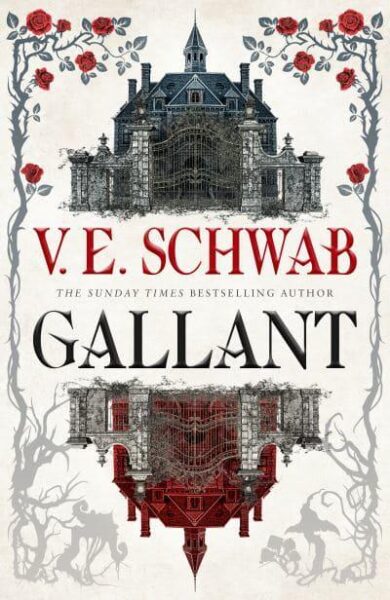
Gallant by V. E. Schwab is a book I struggled to connect with right up to the final page — from the way the story is told to the meaning behind its very premise. The novel has all the ingredients of a magnificent Gothic story: an old family estate, a mysterious past, a parallel world, and a heroine desperately searching for her place among the living. But a compelling concept alone is not always enough.
The story follows fourteen-year-old Olivia, who grows up in a girls’ school that also serves as an orphanage. She cannot speak, has never known her parents, and her constant companions are the ghouls that only she can see. She treasures her mother’s journal as a precious relic. In its final pages, her mother warns Olivia that she will only be safe if she stays away from the family estate of Gallant.
But Olivia, who dreams of having a family, disregards the warning. She receives a letter from an uncle she has never met and arrives at Gallant. Soon, however, she discovers that her uncle is dead, that she is unwelcome by her only living relative — her cousin Matthew — and that beyond the estate’s wall lies another, darker version of the very same house.
A place where two realities exist side by side certainly captures one’s attention. And then, very quickly, loses it.
A Story That Stands Still for Far Too Long
There are several reasons for this. The novel’s central emotional conflict revolves around Olivia’s desire to have a family. Throughout the first third of the book, this recurring theme is repeatedly reinforced through similar situations. Presumably, the intention is to make her decision to remain at Gallant more understandable, but for me, it is perfectly understandable from the beginning.
I do not need to be constantly reminded that a girl who grew up without parents dreams of having a home. The next section of the novel largely repeats the first. Olivia still does not understand why Matthew insists that she leave the estate, while she continues to search for reasons to stay. We learn more about her mother’s journal, yet the story still progresses far too slowly.
It is only in the final third that the pace suddenly accelerates. Olivia crosses the wall, and the events that follow place the characters in mortal danger. The contrast between the different sections of the novel is so pronounced that one is left with the impression that the author has spent too much time convincing us of her heroine’s motivations and too little developing the world in which those motivations matter.
Where Does Mystery End and a Lack of Explanation Begin?
For me, the novel’s very concept is its greatest disappointment. Schwab creates a world in which the boundary between life and death takes on a physical form, and one family is unusually bound to the existence of that boundary.
But why this particular family? What makes its members so special? Why is Gallant the place where these two realities meet? How did this world come into existence, and what rules govern it?
I do not expect a Gothic novel to provide me with a scientific explanation for the existence of the supernatural. Nor do I expect every mystery to receive a definitive answer. But I do expect the world to have a sufficiently developed internal logic for me to accept what happens within it.
In Gallant, far too many of these phenomena have to be accepted on the basis of one simplistic explanation — they simply exist. And when the novel’s entire conflict is built upon them, that becomes a problem.
What Is the Price of Belonging?
Beyond its fantastical elements, Gallant is essentially a story about belonging. Olivia is prepared to risk her own safety to gain something she has never had — a home and a family. And here, Schwab raises an interesting question: what are we willing to sacrifice in order to belong somewhere?
Unfortunately, this theme also remains underdeveloped. For me to become emotionally invested in Olivia’s choice, understanding why she wants a family is not enough. I also need to feel the value of the relationships for which she is willing to risk her life. Yet with the exception of Olivia herself, the other characters are not given sufficient depth. This deprives the ending of much of its emotional weight.
The novel is aimed at a younger audience, but I do not consider that an adequate explanation for its shortcomings. A story can be accessible to younger readers while still offering complex characters, convincing worldbuilding, and plenty of food for thought.
BOOKLOVERS Rating: 2.5 out of 5 stars.
The world of Gallant remains far too underdeveloped given the possibilities the author herself creates. We have a fourteen-year-old girl who must pay a price to have a home and a family, yet neither the world around her nor the characters inhabiting it manage to give that sacrifice sufficient weight.
I expected more from V. E. Schwab, whose novel The Invisible Life of Addie LaRue is among my favorite books. In both novels, the author places her heroines in supernatural circumstances to explore profoundly human needs.
In The Invisible Life of Addie LaRue, the fantastical premise adds depth to the human story. In Gallant, for me, it never quite manages to do so.
Join the community
Your library starts here
Every book leaves a mark.
Create your profile and turn what you read into your personal library.
Follow us on social media:
Have you read the book?
Rate it and share your thoughts with the Booklovers community.
Readers’ rating
★
★
★
★
★
No ratings yet
Log in to rate this book.



No comments yet. Be the first.