

Article
Fantasy · 6 min read
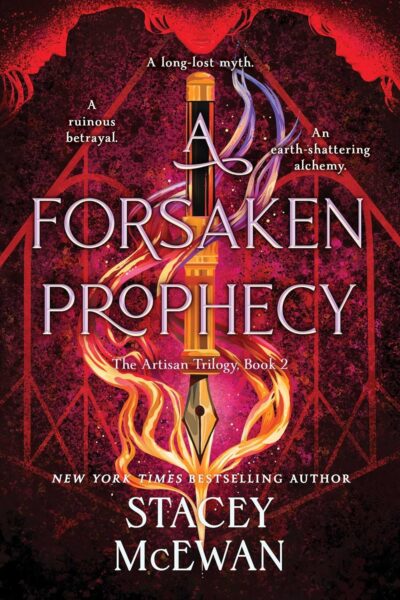
A Forsaken Prophecy
Stacey McEwan
When Revolution Is No Longer an Idea, but a War
Link copied
Once, Nina Harrow and Patrick Colson believed that if they uncovered the truth, they could change the world. Now they know they also have the power to destroy it. In A Forsaken Prophecy, Stacey McEwan returns to the dark industrial world of The Artisan Trilogy, but this time the revolution is no longer a promise, a secret, or an idea waiting to erupt. It has already happened. And people are dying because of it.
The sequel to A Forbidden Alchemy reunites us with Patrick and Nina as they face the consequences of the choices they made in the first book. The Artisan rebellion has nearly collapsed, the war has already claimed thousands of lives, and the two people who once believed they could fight the system together can now barely stand on the same side.
And this is where the novel asks a much more uncomfortable question: What happens to revolutionaries when the revolution starts killing people?
Patrick Is No Longer Just the Antihero in the Flat Cap
In A Forbidden Alchemy, the Tommy Shelby inspiration was almost impossible to miss. Patrick smoked cigarettes, wore a flat cap, ran a criminal organization, and lived by that particular moral code that can make an antihero both dangerous and compelling. But in the second book, his character has to face the consequences of his own revolutionary idealism.
Patrick is the last alchemist. And he believes he has failed. The war he helped start now has very real victims, the rebellion is falling apart, and he is left with the conviction that the blood of the dead is on his hands as well. The first book asked who has the right to possess magic. The second seems to add another question: What right do you have to lead people into war if you cannot promise what will remain when it is over?
And Nina Can No Longer Simply Refuse to Choose a Side
For Nina, the change is different. At the beginning of the series, she believed magic could be her way toward a better life. As the daughter of a mining family, she knew the system primarily through the limitations it imposed on her. Then she discovered that the entire system was built on a lie.
In A Forsaken Prophecy, the time when she could simply observe the world around her and pretend that her choices affected only herself is over. Her betrayal of Patrick is no longer simply a romantic obstacle that needs to be overcome before the next kiss.
It is part of the political catastrophe surrounding them. The trust between them is practically gone. Except the world has a rather cruel sense of humor and places them side by side once again.
A Prophecy and an Inexhaustible Source of Power
When hope for the rebellion is almost gone, Nina and Patrick learn of an ancient prophecy. It may lead them to an inexhaustible source of power. In a world where Terranium is not merely a magical mineral but the foundation of the economy, political power, and class division, such a discovery could obviously change everything.
Neither of them has much of a choice. They have to work together again. Their journey takes them through the dying mining towns of the Belavere Trench, brings them face to face with old friends and enemies, and gradually leads them toward a secret connected to the very origins of magic.
The novel’s official description already suggests that the conflict is expanding beyond the immediate war between the Artisans and those in power. It is also the logical next step for the world McEwan has created. First, we learned that magic was not a gift. Now we are about to discover what it actually is.
The Second Book Was Never Supposed to Look Quite Like This
Interestingly, The Artisan Trilogy was not originally meant to be a trilogy at all. McEwan sold the project as a duology and initially plotted the story across two books. Her editor, however, spotted the obvious problem: there was simply too much material for two novels. Since McEwan did not want to write enormous volumes, the story was restructured into three parts before the first book was even finished. According to the author, however, it was the second book that disrupted the original plan most dramatically and forced parts of the third book to change as well.
And Polly Finally Has Some Explaining to Do
One of the significant changes in the second novel is the introduction of additional points of view. Among them, Polly’s becomes particularly important. After her actions in the first book, McEwan has admitted that the character almost seemed to demand more space in the sequel. But the intention is not to excuse her.
Instead, the author wants to show the context behind her decisions – how hopeless a person’s situation must become before they start making desperate choices.
And Love? It Definitely Does Not Fix Everything
McEwan continues to describe the series as romantic fantasy, and Patrick and Nina’s relationship remains at its center. But if the first book was a slow burn, the question in the second is no longer when the two of them will admit what they feel. They know perfectly well what they felt. The problem is what remains after everything that happened. Betrayal, war, and their own choices have transformed the romantic conflict into something far more interesting than an ordinary breakup.
For them to trust each other again, it is not enough for the feelings to still exist. They have to decide whether the person standing in front of them is still the person they once loved. And whether they themselves are still the same people.
After “Peaky Blinders With Magic” Comes the Harder Part
A Forbidden Alchemy could be described relatively easily with the catchy formula: “Peaky Blinders meets Six of Crows with magic.” A Forsaken Prophecy seems much harder to reduce to a single sentence. The industrial world, criminal organizations, magic, and slow-burn romance are all still there. But now there are consequences. The second book is about what comes after: What will you destroy when you decide to build it all again?
Join the community
Your library starts here
Every book leaves a mark.
Create your profile and turn what you read into your personal library.
Follow us on social media:
Have you read the book?
Rate it and share your thoughts with the Booklovers community.
Readers’ rating
★
★
★
★
★
No ratings yet
Log in to rate this book.



No comments yet. Be the first.