
Article
Historical · 6 min read
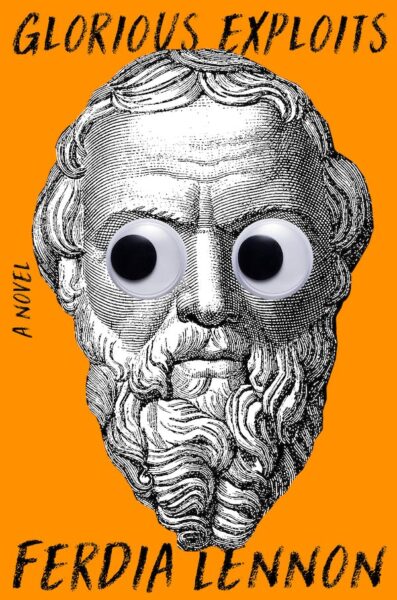
Glorious Exploits
Ferdia Lennon
Can Art Save People While Turning Them Into Spectacle?
Link copied
What is a line from Euripides worth when you are starving? In Glorious Exploits, Ferdia Lennon gives an almost literal answer: food, water, sometimes life itself. The story takes us to Syracuse after the catastrophic end of the Athenian expedition to Sicily during the Peloponnesian War. Thousands of defeated Athenians are taken prisoner, and some of them are confined in vast stone quarries outside the city under almost inhuman conditions.
And then two poor Syracusans, Lampo and Gelon, decide to do something completely absurd. They are going to stage a play. Then another one. And not with professional actors, but with captured Athenian soldiers. The choice of plays is not accidental either: Euripides’ Medea and The Trojan Women. The condition is simple: if you remember the lines, you get a role. And a role means food.
The Trojan Women, meanwhile, is a tragedy about the women left behind after the destruction of Troy, reduced to spoils of war by the victors. It is difficult to imagine a more darkly ironic choice and it is certainly not accidental. And so, in the debut novel by Irish writer Ferdia Lennon, theatre stops being a metaphor for salvation.
It can literally save a life. But this is also where a much more uncomfortable question begins: Can art humanize suffering while simultaneously turning it into spectacle?
A Story That Sounds Invented but Comes From Plutarch
The most unbelievable part of the premise of Glorious Exploits was not actually invented by Lennon. After the Athenians were defeated near Syracuse in 413 BCE, prisoners really were confined in the quarries. Thucydides describes how they were kept there as if in the most secure prison imaginable, while Plutarch later writes about disease, hunger, and meagre rations that killed many of them.
But Plutarch adds one remarkable detail. According to him, the Sicilians were passionate admirers of Euripides. Some of the surviving Athenians later claimed that they had received freedom, food, or water because they were able to recite passages from his works. For Lennon, that single story already contained an entire novel: art as a literal lifeline.
Why Tragedy?
Lennon has said that what attracted him from the beginning was not only ancient mythology, but the strange human need to tell the darkest stories even when we ourselves are living through disaster.
“On a basic level they’re brilliant stories,” he says of Greek mythology. He does not reconstruct antiquity in solemn, distant language. His narrator, Lampo, speaks in a modern, almost Dublin-like rhythm, while absurdity and profanity exist alongside hunger, slavery, and death. It is precisely this clash that makes the book both comic and deeply uncomfortable.
The Irish Times described the novel as one of the year’s most original debuts and highlighted the contrast between its contemporary conversational voice and its serious themes of war and forced displacement.
Historical Fiction as a Strange Form of Speculative Fiction
Lennon himself has an interesting way of thinking about historical fiction. “The human brain hasn’t really changed in hundreds of thousands of years,” he says. “But the culture changes.” That is why historical fiction, to him, almost resembles speculative fiction. Human nature remains relatively recognizable, but you place people inside an entirely different system and watch what they do.
And some patterns repeat. Lennon also points to the Sicilian Expedition itself – a campaign presented partly through the argument of helping allies, while behind it stood much larger political and military ambitions. For him, this is one of those mechanisms of war that continues to look disturbingly familiar regardless of the century.
But when asked what solutions we can take from antiquity, he does not romanticize the ancient Greeks. Quite the opposite. His answer is roughly: What we can learn most clearly is what not to do.
A Black Comedy Built on Mass Tragedy
Perhaps Lennon’s riskiest decision is that all of this is funny. Not constantly. Not because the suffering itself is funny. But because people remain absurd even while the world around them is collapsing.
Lampo and Gelon have absolutely no business organizing a theatrical production. And yet the control with which Lennon moves between farce and tragedy is one of the most frequently praised aspects of the novel.
The Irish Times notes both its “madcap energy” and the empathy with which Lennon writes about friendship, war, and art’s ability to make us look at the person on the other side. The review does, however, raise some reservations, particularly about the heavy use of profanity and a more hurried final section. In other words, the attention surrounding the book is not based solely on its unusual premise.
When Euripides Is Worth More Than Bread
At the heart of Glorious Exploits lies an almost absurd historical story. Once, according to Plutarch, a person could save his life because he remembered a few lines of Euripides. Ferdia Lennon takes that idea and expands it. What happens when art stops being an ornament to life and becomes a means of survival? Does that make it purer?
Or exactly the opposite – when one side has the food and the other knows the lines, does every rehearsal already contain a transaction? Perhaps this is the most interesting contradiction in Glorious Exploits. Theatre allows the victors to see the human being in the enemy. But before they see him as a person, they first make him perform a role. And if Euripides truly did save some of those prisoners more than two thousand years ago, one rather uncomfortable question remains: Does art save a person or does it sometimes simply make everyone else finally notice them?
Join the community
Your library starts here
Every book leaves a mark.
Create your profile and turn what you read into your personal library.
Follow us on social media:
Have you read the book?
Rate it and share your thoughts with the Booklovers community.
Readers’ rating
★
★
★
★
★
No ratings yet
Log in to rate this book.

No comments yet. Be the first.