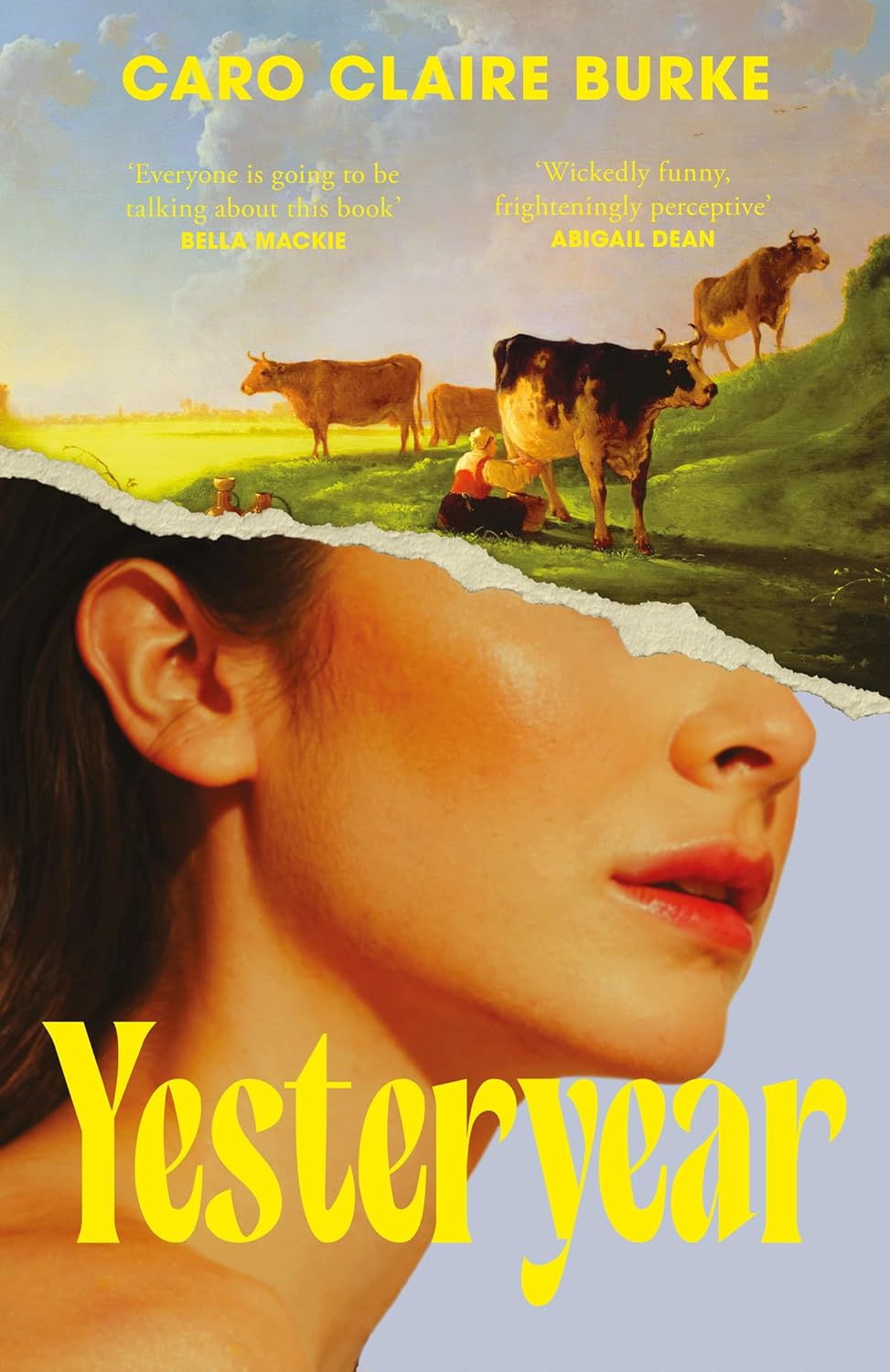
Caro Claire Burke’s Yesteryear received a remarkably convincing marketing campaign, one that also turned it into a bestseller on the Bulgarian market. Add to that the superlatives I came across in the international press, and I decided to give the book a chance. I approached it with quite a lot of prejudice, because the synopsis on the cover did not sound particularly impressive and even seemed somewhat predictable – something along the lines of a satire on the tradwife trend.
In short, at the center of the story is Natalie Mills, who preaches a return to traditional living to millions of followers on social media. Hmm, what exactly do I mean by that? A life in which a woman is the perfect, deeply religious homemaker, has many children, obeys her husband without question, and grows and cooks her own food. In other words, she does not take advantage of the conveniences of the modern world in any way.
Of course, behind the camera, the perfect life at Yesteryear Ranch looks entirely different. Natalie and her husband Caleb have nannies looking after their children, as well as a film crew at their disposal. And cowboy Caleb actually comes from a wealthy family, while his father is running for president.
But one morning Natalie wakes up in a bed that is not her own, beside a husband who is not her husband, surrounded by children who are not her children. And she is forced to live the life she has spent years preaching. She is certain of only one thing: whether she is facing a test from God, has been kidnapped, or is taking part in some kind of reality show, she has to get out. Because this is definitely not the kind of life she wants for herself.
The publication of Yesteryear comes against the backdrop of the popularity of so-called tradwife content on social media – an idealized version of traditional gender roles, homemaking, motherhood, and family life shaped around a clearly defined value system.
Yes, Caro Claire Burke mercilessly dismantles the illusion behind that perfect life, but she also goes further. The story unfolds across two timelines – Natalie’s present life and her past, or, in other words, the facts and circumstances that turned her into the woman she is today. And at times, no matter how clearly you can see how distorted her view of the world is, you find yourself ready to sympathize with her, to excuse her, to hope that she will still do the right thing.
But then you think about the consequences for the children, who pay the price for the isolated way of life they have been trapped in without ever having a say. Because Natalie also presents herself as the perfect mother, while in reality she does not know her children and has no genuine relationship with them. And you begin to wonder: does a woman who “sells” a fake life deserve redemption?
Caro Claire Burke’s ability to provoke such conflicting emotions toward Natalie is one of the strongest aspects of the book. Still, I found myself wishing for a stronger focus on her past.
And the ending – what an ending. Incredible and completely unexpected, but at the same time it felt as though it had been written too quickly and rushed through.
The BOOKLOVERS rating is 4 out of 5 stars.
I understand why Yesteryear became a bestseller. The novel belongs to that kind of harsh realism in which there are no entirely good or entirely bad people, but people whose redemption ultimately depends on themselves. For me, however, the novel raises a more interesting question, one that goes beyond the subject of traditional wives.
How far can we go in building our own system of values and ideas about what is right and wrong? How easily can we lock ourselves inside a bubble where even absurd principles begin to seem perfectly logical? And when do we realize that, while trying so hard to live the “right” way, we have actually forgotten to live at all? I don’t think I have ever used the word “life” so many times in a text as I have in this relatively short review. But that is my reading of Yesteryear – a book that asks more questions than it answers, but one that is unquestionably worth reading.
Join the community
Your library starts here
Every book leaves a mark.
Create your profile and turn what you read into your personal library.
Follow us on social media: