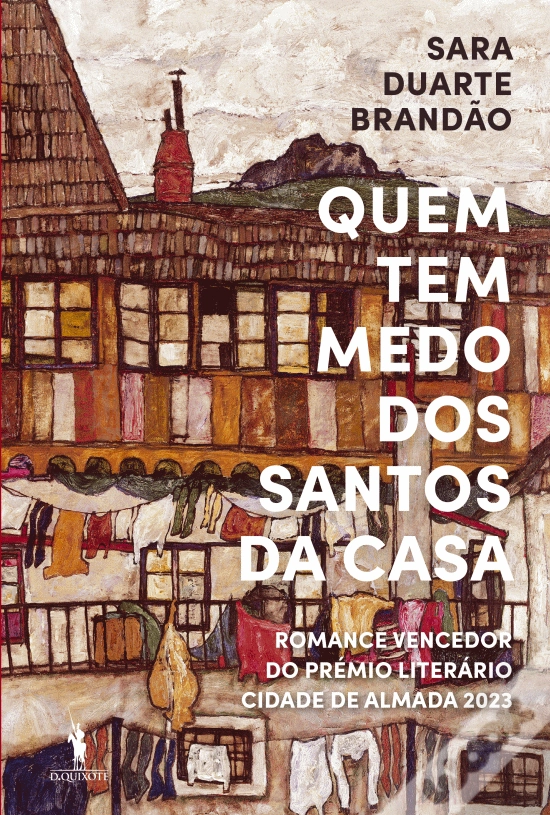
Who’s Afraid of the Saints of the House (Quem tem medo dos santos de casa) by Sara Duarte Brandão tells the story of Maria Teresa, a woman raised in a small Portuguese fishing village between the constraints of family life and the freedom she finds in books.
She is expected to become exactly the kind of woman her father, her husband, and her community have decided she should be. To accept the life already mapped out for her. Not to ask too many questions. Not to dream of things considered unsuitable for a future wife.
But Maria Teresa carries her books to the trees and imagines stories ripening from their branches like fruit. For her, reading is not merely an escape from reality. It is the first possible path to freedom.
The woman who refuses to stay in her place
Maria Teresa’s story unfolds across different periods of her life: as a girl who secretly reads forbidden books, as a woman forced to live according to other people’s expectations, and as an elderly recluse whom the local children call a witch.
In her youth, she comes to know not only the restrictions of family and marriage, but also a secret love that reveals the possibility of an entirely different existence. To reach it, Maria Teresa must leave behind the security of the familiar world and cross the river, both symbolically and quite literally.
This is not simply a journey from one bank to the other. It is a refusal to continue living in the shadow of dreams chosen for her by other people.
The witch’s house
Years later, we find Maria Teresa living in a dark house beside the Douro River, where she spends her days weaving tapestries. To the local community, her home is a suspicious place. A house filled with books, silence, and strange figures. The house of a woman who lives alone and refuses to obey the rules of the community. Therefore, it must be the house of a witch.
Yet where others see darkness, Maria Teresa sees a refuge. A place for creativity, memory, and freedom. A space in which a woman can finally exist beyond the roles imposed upon her by family and society. It is in this house that young Joana appears.
An unlikely friendship grows between them, and Maria Teresa introduces the girl to the world of books. She teaches her not merely how to read, but how to think, feel, and recognize possibility where others see only fear. In Joana, she finds a chance to pass on the freedom she once had to fight for herself.
A novel inspired by a true story
At the heart of Who’s Afraid of the Saints of the House lies a real event involving religious sculptures created by Portuguese artist Altino Maia for the Church of São Pedro da Afurada. The unusual figures provoked a powerful reaction within the local religious community and were eventually removed from the church.
Their story provides the novel with more than its setting. It also gives rise to its central question: What are people truly afraid of when confronted with something they do not understand?
The figures themselves? The woman who refuses to behave as expected? Or the possibility that everything they consider fixed and unquestionable might, in fact, be different?
Maria Teresa’s name is equally deliberate. It is a direct reference to the Portuguese writer, journalist, feminist, and activist Maria Teresa Horta. Horta was one of the authors of the celebrated New Portuguese Letters, a book that became a symbol of resistance against censorship, patriarchal restrictions, and the subordinate position of women in 1970s Portugal.
A life built fragment by fragment
Who’s Afraid of the Saints of the House does not tell Maria Teresa’s life in chronological order.
The novel moves between different moments and perspectives, while the reader gradually reconstructs her story like a mosaic—fragment by fragment, memory by memory. The past remains alive in the house, in the tapestries, in the books, in the body, and in the unspoken stories of women.
A novel for the women who were never allowed to become themselves
Sara Duarte Brandão dedicates the book to the many women who, for generations, were denied the opportunity to become who they truly wished to be. And this is perhaps where the essence of the novel lies.
Who’s Afraid of the Saints of the House is a story of emancipation, but it does not portray freedom as a single heroic act. It is made up of many small acts of defiance: a hidden book, a forbidden love, a river crossed, a home chosen in solitude, a friendship between two generations.
It is a novel about the women communities turn into witches when they cannot force them into submission. About books as refuge and as a way of imagining another life. About art that can dismantle established ideas of what is beautiful, proper, and sacred. And about the freedom to plant thoughts, even when everyone around you insists they should never be allowed to grow.
Join the community
Your library starts here
Every book leaves a mark.
Create your profile and turn what you read into your personal library.
Follow us on social media