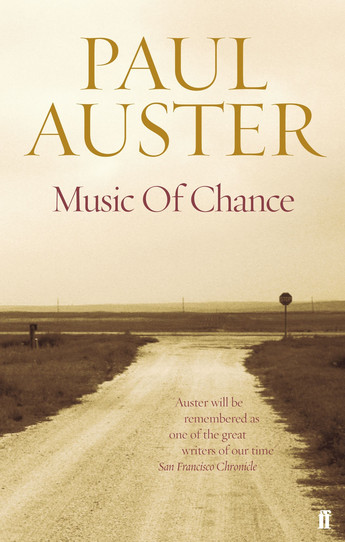
The Music of Chance, Paul Auster
On the surface, The Music of Chance is a story about risk and bad decisions. Beneath that surface, however, lies something much deeper. Paul Auster is interested in a question that has fascinated philosophers for centuries: how much of our lives are actually governed by our own choices?
Some novels tell a story. Some novels ask questions. And then there are books like The Music of Chance by Paul Auster — novels that quietly force readers to wonder whether they have ever truly been in control of their own lives.
Published in 1990, The Music of Chance remains one of Auster’s most fascinating early works. It contains many of the themes that would later define his career: coincidence, identity, freedom, fate, and the invisible forces that redirect our lives without warning.
At first glance, the premise seems deceptively simple. After the death of his estranged father, former firefighter Jim Nashe unexpectedly inherits a substantial sum of money. Rather than investing it or rebuilding his life, he abandons everything and sets off across America, driving aimlessly from one state to another. Freedom becomes an obsession.
But when the money begins to run out, Nashe encounters Jack Pozzi, a young professional poker player convinced that one big win can change his fortunes forever. Together they decide to challenge two eccentric millionaires to a high-stakes poker game.
What follows is not merely a gamble. It is the beginning of a strange and increasingly unsettling descent into a world where chance, power, and human vulnerability become impossible to separate.
On the surface, The Music of Chance is a story about risk and bad decisions. Beneath that surface, however, lies something much deeper. Paul Auster is interested in a question that has fascinated philosophers for centuries: how much of our lives are actually governed by our own choices?
And how much is determined by pure accident? One of the most striking aspects of the novel is the way Auster refuses to provide easy answers. Events unfold with an almost dreamlike inevitability. Coincidences occur. Fortunes change. Lives shift direction. Yet everything feels strangely believable. Perhaps because life itself often works the same way.
In interviews, Auster frequently spoke about the role of contingency in both literature and everyday existence. Speaking with Interview Magazine, he described how his books often begin as little more than a sensation or a rhythm—a „buzz in the head“ that gradually develops into narrative.
For Auster, the title The Music of Chance was never simply metaphorical. It reflected his belief that life moves according to patterns we rarely understand while we are living through them.
The rhythm of language mattered just as much. In conversations about his writing process, Auster often compared prose to music, explaining that finding the right sentence rhythm required endless revision. The physical sound of language was as important to him as plot or character.
That attention to rhythm is evident from the very first pages of the novel. The opening moves with remarkable speed. Within a handful of chapters, Nashe’s life is dismantled and reconstructed. His marriage has failed. His daughter is being raised elsewhere. An inheritance arrives from a father he barely knew. He abandons stability and embraces uncertainty.
And while readers instinctively search for clear causes and effects, Auster seems determined to challenge that instinct. What if there is no grand design? What if life is simply a series of accidents that we later transform into stories? That question sits at the heart of The Music of Chance.
More than thirty years after its publication, the novel remains strikingly relevant because it refuses to offer comforting conclusions. Instead, it invites readers to confront the unsettling possibility that randomness plays a far greater role in our lives than we would like to admit.
For many readers, Paul Auster will always be associated with The New York Trilogy. For others, his masterpiece is 4 3 2 1. Auster himself described that monumental work as the defining novel of his career. In many ways, the seeds of 4 3 2 1 can already be found in The Music of Chance.
Both novels explore how small decisions and seemingly insignificant events can radically alter a person’s destiny. Both question the stability of identity. And both suggest that alternative versions of our lives may exist just beyond the paths we happened to take.
As we wrote in our review of 4 3 2 1: „Its scale simply cannot be contained within conventional literary boundaries.“
And perhaps even more importantly: „It is the kind of book after which you are no longer quite the same person.“
The same could be said – on a smaller but equally profound scale—about The Music of Chance. This is not merely a novel about poker, money, or bad luck. It is a meditation on freedom.
A reflection on the fragile relationship between choice and destiny. And a reminder that sometimes the most important moments in our lives arrive without warning, disguised as coincidence.
Join the community
Your library starts here
Every book leaves a mark.
Create your profile and turn what you read into your personal library.
Follow us on social media: