Review
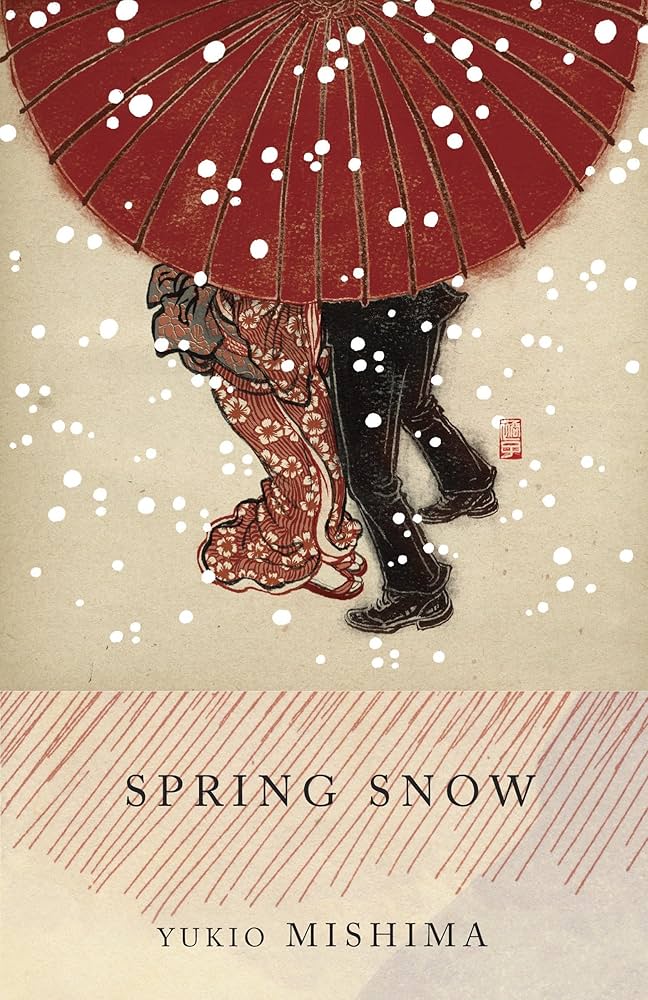
Spring Snow by Yukio Mishima is not merely a novel, but an experience that completely takes over your mind. It is a tragic love story in which even nature itself seems synchronized with the emotions and destinies of the characters. This is the story of Kiyoaki and Satoko — one you are unlikely to forget. But let’s begin with the plot itself.
The novel opens in the aftermath of the Russo-Japanese War, though the real story unfolds after the death of Emperor Meiji in 1912. Kiyoaki Matsugae and Satoko Ayakura belong to two closely connected yet fundamentally different families. The Ayakuras are part of Japan’s old aristocracy, while the Matsugaes are newly wealthy former samurai who gained status through the modernization and wars of the Meiji era.
Kiyoaki’s father sends him to live with the Ayakuras so he can absorb their refinement and culture. Instead, he becomes deeply melancholic, passive, and emotionally paralyzed.
In fact, Kiyoaki is one of the most spoiled, indecisive, and frankly unpleasant literary characters I have ever encountered. His only obvious “virtue” is his physical beauty, and thanks to his privileged social position, he has never had to truly fight for anything in his life. He is a coward shaped entirely by his culture.
On the opposite side stands Satoko — hopelessly and blindly in love with Kiyoaki since childhood. And through a strange emotional awakening, Kiyoaki eventually convinces himself that he loves her as well. “Convinces” may be the right word here, because Kiyoaki is profoundly disconnected not only from others, but from himself. Even after beginning a secret affair with Satoko, he remains uncertain about his own emotions, at times believing she merely wishes to humiliate him.
And when he finally understands the depth of his feelings, it is already too late. This is a brutal story — emotionally ruthless and painfully honest. The characters’ flaws are deliberately magnified, not only through Kiyoaki’s cruelty toward Satoko, but through the entire society surrounding them. Even secondary characters, such as Satoko’s maid and Kiyoaki’s tutor, become essential contributors to the unfolding tragedy. Because in Mishima’s world, love does not fail because of a lack of feeling. It fails because it was never allowed to exist freely in the first place. Like spring snow itself, love here is beautiful, fragile, and destined to disappear almost immediately after it appears.
Readers familiar with Japanese history — particularly fans of James Clavell’s Asian Saga — already know that the collapse of the Shogunate marked the beginning of Japan’s rapid modernization and Westernization. Homes became decorated in European style. Women copied Western hairstyles and fashion. But Western influence in Spring Snow goes far deeper than aesthetics.
The novel also reveals Yukio Mishima’s own views on Japan and what he perceived as its spiritual decline. I was genuinely surprised to later learn that Mishima himself attempted to organize a coup in defense of the Emperor — and after its failure committed ritual seppuku. While reading Spring Snow, you may occasionally feel as though nothing is happening.
In reality, everything is happening. Just not through action. It happens through emotional states, silence, hesitation, longing, shame, and fear. And nature constantly mirrors those inner transformations.
BOOKLOVERS Rating: 5/5
Spring Snow is a magnificent novel — one of the best books I have ever read. This is not simply a love story. It is a story about missed courage. About emotions that arrive too late.
And about people who are unable to follow them when they finally do.
Join the community
Your library starts here
Every book leaves a mark.
Create your profile and turn what you read into your personal library.
Follow us on social media: