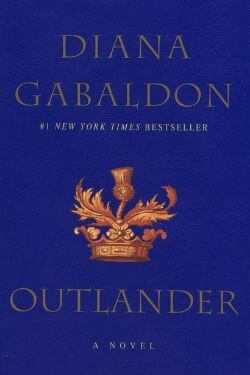
This is one of those reviews I hoped I would never have to write quite like this. Diana Gabaldon’s Outlander is an established fantasy novel with strong historical elements, and over the years since the first book in the series was published, its fanbase has only continued to grow – helped, of course, by the hugely successful television adaptation.
After reading so many glowing reviews and hearing enthusiastic recommendations from friends, I opened the first pages with genuinely high expectations. That enthusiasm did not last long.
Most readers are probably already familiar with the premise, or at least have a vague idea of the story. In 1945, nurse Claire Randall passes through an ancient stone circle in Scotland and finds herself transported two hundred years into the past—to 1743, to be precise.
Her medical skills soon prove essential when she helps save the life of the injured Jamie Fraser, who later becomes her husband largely out of necessity. Claire eventually falls in love with him and is forced to choose between Jamie and the husband she left behind in the twentieth century – the peaceful historian Frank Randall.
One particularly intriguing detail is that Claire’s greatest enemy in the past—which quickly becomes her new present—is Captain Jack Randall, an English officer notorious for his cruelty and sadism.
The strengths of Outlander are obvious. The premise is original, Claire is a strong and fully realized female protagonist, and many of the secondary characters are equally convincing. Gabaldon creates a fascinating version of Scotland where mythology and folklore collide with extreme religiosity. The political intrigue at Castle Leoch, home of Clan MacKenzie, and the mystery surrounding Jamie’s true identity are also strong elements of the story.
But perhaps one of the smartest choices is the historical period itself. The novel takes place only a few years before the Jacobite Rising and its catastrophic end, when Bonnie Prince Charlie would unite many of the Scottish clans and promise them freedom in exchange for helping him reclaim the British throne.
Unfortunately, that is more or less where the novel’s strengths end. And those strengths are not insignificant. Perhaps I simply expected too much. Shortly after the halfway point, the novel loses momentum almost completely. Maybe the intention is to shift the focus toward Jamie and Claire’s relationship – two people from radically different centuries who somehow fall in love despite everything separating them. But I’m not entirely convinced.
At times, it felt more as though someone had told Gabaldon the novel needed to be more than 700 pages long, and she decided that around a hundred of those could comfortably be devoted to sex, while another hundred and fifty could go to scenes that contribute very little to the actual story.
The real problem is repetition. Claire is in danger, Jamie rescues her. Jamie is in danger, Claire rescues him. A great deal of sex happens between the rescue missions. Then comes another danger. Another rescue. More sex. At some point, the pattern stops developing either the relationship or the characters with the same intensity.
The scenes involving violence, torture, and sexual assault are also described at considerable length and in graphic detail, and I’m not convinced they add enough to justify how much space they occupy. By the end, I admit I skipped several pages simply because… I already knew Gabaldon was extremely good at describing them.
But the biggest weakness for me is Claire’s almost complete lack of curiosity about the phenomenon of time travel itself. She is a modern twentieth-century woman. She has been married to a historian. She understands science. And yet she seems to adapt almost immediately to her new reality without seriously questioning how any of this is possible.
You would expect at least some psychological inability to process what has happened to her. How did she travel through time? Why? Are there others like her? There are. What exactly are the stones? Why do they work? Perhaps the later books explore these questions more deeply, but at this point, I am not particularly optimistic.
BOOKLOVERS Rating: 3/5
It is an encouraging three stars. We have read worse books and, out of mercy, given them the same rating, but in this case the gap between expectation and reality was simply too wide.
And if someone had warned me beforehand, I probably would have chosen the television series instead. Judging by the opening episodes of the first season, and despite the inevitable differences from the book, the adaptation feels considerably more realistic, more focused, and ultimately more compelling.
Join the community
Your library starts here
Every book leaves a mark.
Create your profile and turn what you read into your personal library.
Follow us on social media: