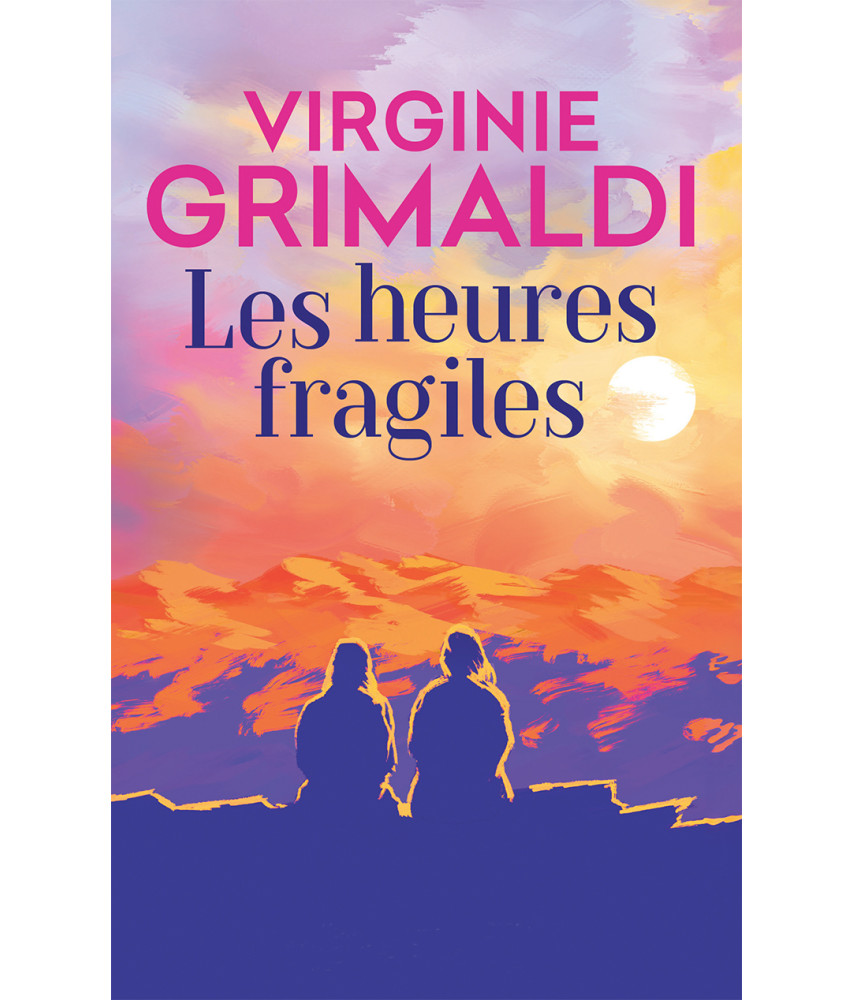

How is it possible to live under the same roof as your child and not realize how deeply they are suffering?
That painful question lies at the heart of Fragile Hours (Les Heures fragiles) by Virginie Grimaldi – an intimate novel about maternal love, the relationship between a mother and daughter, and the wounds passed from one generation to the next.
Diane has always dreamed of a perfectly ordinary life: a husband, two children, and a job she loves. She has received more than she ever dared to hope for.
Then her husband leaves her. As Diane struggles to understand how her life has fallen apart so suddenly, she fails to notice that she is not the only one in pain. Just a few metres away, in the room across from hers, her sixteen-year-old daughter Lou is gradually losing the ability to smile.
The pain in the next room
At first glance, Lou appears to be going through her first heartbreak. But there is far more behind it. When Diane finally realizes how serious her daughter’s condition has become, she faces the shock that probably haunts every parent:
How did she fail to see it? They live in the same home. They share the same daily routine. They pass each other in the hallway, eat at the same table, and hear one another through the walls.
And yet Lou has been left alone with thoughts no child should ever have to carry without help. Les Heures fragiles is not only about the suffering of a teenage girl. The novel also follows the helplessness of a mother who desperately wants to save her child but does not know how to reach her.
Diane comes to understand that love is not always enough. Sometimes, you must first learn how to truly see.
The girl who feels the world too deeply
Lou is caught in that uncertain space between childhood and adulthood, when everything feels more intense, faster, and more painful: first love, relationships with others, pressure at school, a changing body, and the fear that you do not belong anywhere.
She is confronted with questions about death, injustice, violence, and the world in which she must somehow find her place. Lou experiences everything like an antenna that cannot be switched off. She feels too much, but cannot find the words to explain what is happening inside her.
Grimaldi does not portray teenage pain as a whim or a temporary drama. She treats it as a reality that adults too often minimize simply because they do not know how to understand it.
Mother and daughter as reflections of each other
The novel alternates between the voices of Diane and Lou.
Gradually, we realize that they have far more in common than either of them understands. Both are at a turning point. Both are experiencing loss. Both must let go of the future they once believed was waiting for them.
Their vulnerabilities reflect one another. As Diane tries to reach her daughter, she is forced to return to her own past—to the wounds she has spent her whole life avoiding and the truths she has never been able to speak aloud. Because sometimes, before you can help someone else stand up again, you must first admit where you yourself have fallen.
A story born from Virginie Grimaldi’s personal experience
Les Heures fragiles is one of Virginie Grimaldi’s most personal novels.
The author has explained that Lou was inspired by her own difficult adolescence, a period that remains deeply sensitive for her even today. “I was like Lou. I had dark thoughts and needed help from professionals. And now I am the mother of a teenager, and we know that teenagers today are not doing well.”
Grimaldi is encouraged that people are gradually becoming more open about mental health.
“I feel as though it is no longer a source of shame, which is wonderful. I often talk about mental health problems; I even wrote about bipolar disorder in an earlier novel. These are subjects very close to my heart, and I think it is wonderful that we can talk about them without feeling ashamed.”
When asked what she would say to her teenage self, Virginie Grimaldi replied:
“Above all, I would tell her that it can pass. That is what I tell my son today—that you can learn to live with it. You can be happy despite it. At the time, I did not believe that. When I was seventeen, I was convinced that my life would be hell and that it was not worth living.”
The writer who works by instinct
Virginie Grimaldi describes her style as contemporary, rhythmic, and musical, with an ever-present touch of humor.
“I am the least organized person in the world. I procrastinate a lot, and I am very much an observer. The stories form in my head, they come alive, and then at some point I begin writing them on my computer.”
Once that moment arrives, she writes every day for several months at home, in complete silence, usually sitting on the sofa in her pajamas with her feet on the table.
Her stories almost always begin with something personal. An experience, a memory, or a feeling around which the fictional world gradually takes shape. That may be why her characters feel so close to readers. She does not observe their pain from the outside. She writes from a place she knows herself.
France’s most widely read female author
Since the publication of her debut novel, The First Day of the Rest of My Life, in 2015, Virginie Grimaldi has released a new bestseller almost every year.
Her books have sold millions of copies and been translated into more than twenty languages. In 2025, she topped the ranking of France’s bestselling French authors, while Fragile Hours became another major success in her career.
Within its first week of publication in France, the novel had already reached tens of thousands of readers.
That success is unlikely to be explained only by Grimaldi’s ability to make readers laugh and cry within the same page.
A novel about falling, but above all, about getting back up
Les Heures fragiles addresses teenage mental health with tenderness without ever minimizing the weight of what is being experienced. It is a novel about falling, but above all, about the ways we find our feet again.
About a mother who understands that she cannot tear the pain out of her child, but she can remain beside her. About a daughter who must learn to believe that today’s suffering is not a sentence for the rest of her life. And about those fragile hours in which a single word, a conversation, or an outstretched hand can become the difference between despair and hope.
Join the community
Your library starts here
Every book leaves a mark.
Create your profile and turn what you read into your personal library.
Последвайте ни в социалните мрежи: