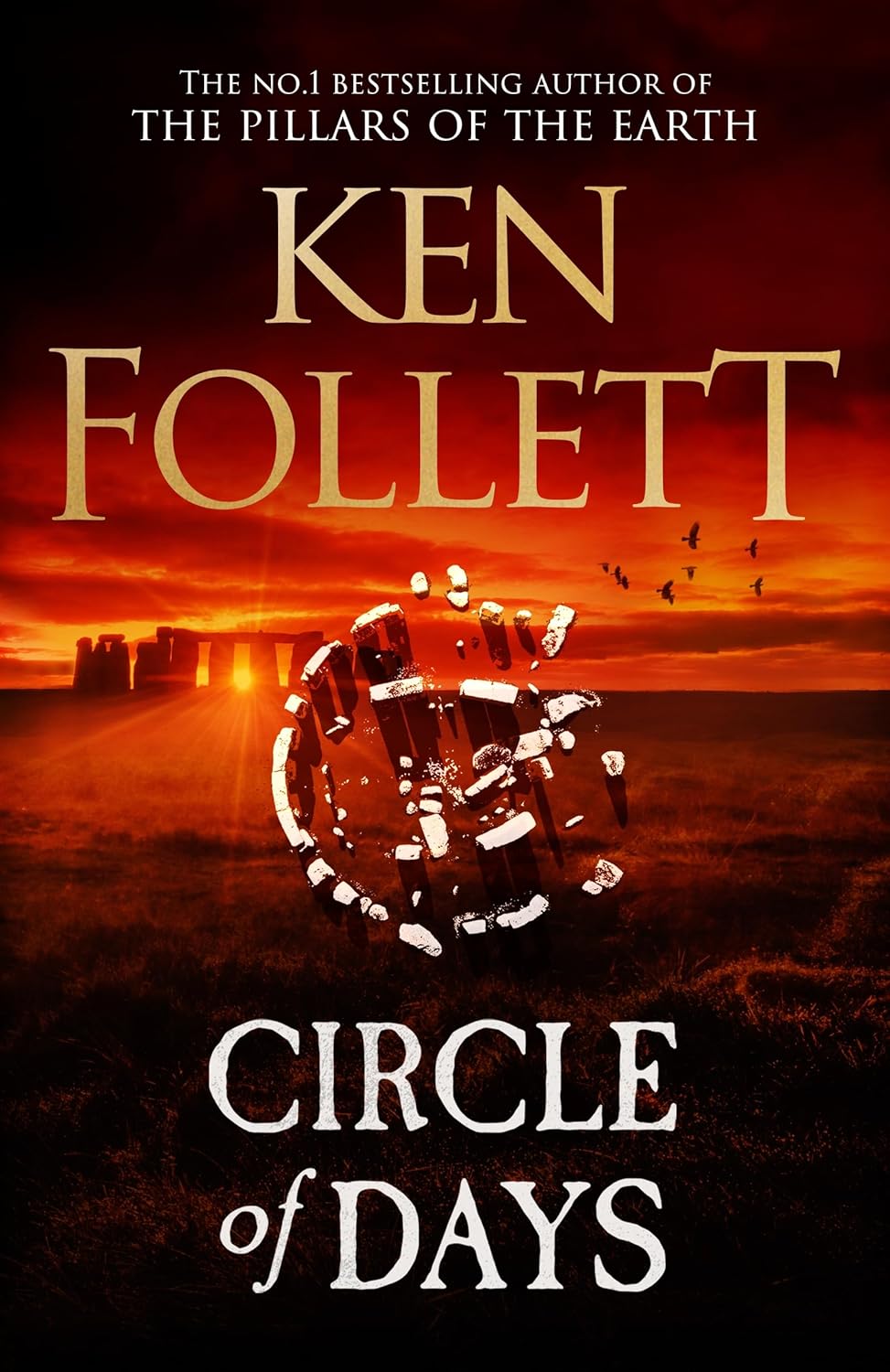
Writing a historical novel about medieval England means working with chronicles, documents, architecture, laws, names, and recorded events. Writing one about the people who built Stonehenge around 4,500 years ago is an entirely different challenge – and that is precisely the challenge Ken Follett takes on in Circle of Days.
At the center of the story are Seft, a young and exceptionally skilled flint miner, and Joia, a priestess with an ambitious vision for an enormous stone monument. Around them live herders, farmers, and forest people whose relationships gradually shift from distrust to open conflict. But how much do we actually know about this world? And where does archaeology end and Ken Follett begin?
It All Starts With One Question: How Did They Build It?
Stonehenge was not unfamiliar to Follett. He visited the site with his family as a child, but the idea for a novel came decades later. “The first thing is the size of these stones there, seven or eight yards high and they weigh about 25 tonnes. When you stand close to these enormous stones, you get a feeling that you’re next to something that’s really special. It’s really extraordinary. It’s been there for 4,500 years and nobody knows why. So that caught my interest.”
The spark for the novel itself came almost by accident: “It’s kind of a funny thing, really. I saw a book, I didn’t even read this book at the time, although I have since, I just saw the title: How to Build Stonehenge. And I thought, ‘Wow, that sounds like a Ken Follett book.’ Of course, now I’ve read the book and eventually got to know the author, who’s an archaeologist called Mike Pitts, and began to get into the intricacies of this place. But that was the spark. The spark was just that title.”
The comparison with Follett’s most famous novel comes almost automatically. In The Pillars of the Earth, he turned the construction of a medieval cathedral into the driving force behind an enormous human story. Here, he does something similar – only he goes back roughly another 3,500 years. And that changes everything.
What Do We Actually Know in Circle of Days?
Archaeology can give us fairly precise answers about Stonehenge itself. Not necessarily about the people who lived around it. The first major structure at the site was not the stone circle we know today. By around 3000 BC, there was already a circular ditch and bank, along with 56 pits now known as the Aubrey Holes. The site was also used for cremation burials.
Around 2500 BC came the phase Follett places at the heart of his novel: the raising of the enormous sarsen stones. More than 80 were transported to the site, with an average weight of around 25 tonnes. The smaller bluestones came from Wales, more than 250 kilometres away. Here, the novel rests on an exceptionally solid historical foundation.
Building a complex on this scale would have required hundreds of people, careful organisation, food, ropes, timber, stone tools, and extraordinary logistics – all in a period before metal tools and before wheeled transport was in use in Britain.
This is where Seft – practical-minded and able to understand how materials and structures work – starts to feel much less like a convenient fictional invention. Someone like him probably existed. We simply do not know his name.
But Joia? The Tribes? The War?
This is where the novel begins. There is no evidence that a charismatic priestess dreamed up Stonehenge. There was no recorded Seft. No Niene. And there is no evidence of a specific war between herders, farmers, and forest communities that determined the monument’s fate.
Even when it comes to the organisation of the builders, archaeology cannot give us a definitive answer. We know the project required a vast coordinated effort, but there is no direct evidence telling us who was in charge or what the social hierarchy looked like.
Follett does not hide this. Unlike historical periods in which almost every detail can be checked against written records, here he has admitted that he had to reason, speculate, and imagine far more. After completing the first version of the novel, he gave the manuscript to specialists to look for historical and archaeological errors.
Perhaps the Most Historical Thing in the Book Is the People
This is where one of Follett’s most interesting ideas comes in. We may have no idea what a woman living on the Great Plain around 2500 BC was called, but we can be fairly certain that she worried about food, family, safety, relationships, and the future of her children.
For Follett, time changes technology far more than it changes fundamental human fears. “In every historical age, people are anxious about money and work, making a living, feeding their children. People are anxious about violence, crime and war, or they’re anxious about marriage and sex. All of these things were issues in pretty much every human society as far as I can make out, and also in different countries.
My books are popular in places like China and Brazil, where everyday life is really very different from anything that I normally write about, England in the Middle Ages or Victorian bankers. But I think people whose life circumstances are different can enjoy those books because they can identify with these fundamental issues that worry everybody.”
That also explains why the official synopsis can be slightly misleading. Stonehenge is the big idea, but this is not simply 600 pages about dragging stones across a plain. Drought, love, domestic violence, power, religion, trade, conflict between communities, and competition for resources are what transform an archaeological problem into a human story.
But Is That Story Convincing?
This is where the reviews become more interesting. Professional criticism has been largely positive, but one reservation appears repeatedly. A review in The Washington Post points to the unusually simple language of the novel – even more direct than Follett’s traditionally straightforward style. Some reader reactions have also been more critical, arguing that despite the book’s considerable length, Stonehenge itself remains in the background for too long, while some characters and conflicts feel more schematic than those in his strongest historical novels.
So, How Much History Is There in Circle of Days?
More than it may first appear. And at the same time, much less than we are used to expecting from a historical novel. Archaeology tells us that 4,500 years ago, someone decided to move stones weighing dozens of tonnes and arrange them with extraordinary precision in one place in southern England.
Circle of Days tries to imagine the person who might have said: “Let’s do it.” And the people who, for whatever reason, believed them.
Join the community
Your library starts here
Every book leaves a mark.
Create your profile and turn what you read into your personal library.
Follow us on social media: