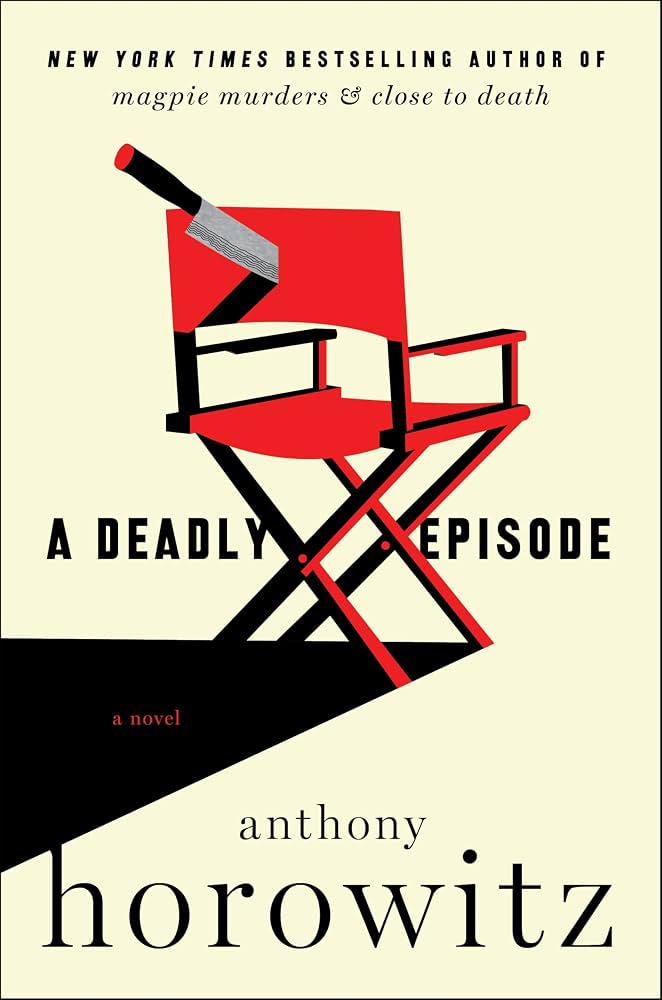
A Deadly Episode, Anthony Horowitz
The official description presents the case as Hawthorne’s most personal investigation yet, as the clues gradually lead back into his past – and toward the possibility that years ago he made a mistake someone now intends to make him pay for.
How many layers of fiction can one murder contain? In A Deadly Episode, Anthony Horowitz seems determined to test the limit. The real-life author Anthony Horowitz writes a novel about a fictional version of himself, who finds himself on the set of a film adaptation of the first book in his own series. And the person who ends up dead is the actor chosen to play the fictional detective Daniel Hawthorne.
Confused? That is only the beginning. The sixth novel in the Hawthorne and Horowitz series opens during the filming of an adaptation of The Word Is Murder. The production is already over budget, the director behaves like a man whose ego far exceeds everyone else’s patience, the screenwriter has little respect for detective fiction, the two stars despise each other, and the producer is facing serious financial trouble.
Then David Caine, the actor playing Hawthorne, is found stabbed to death. But very quickly, the central question stops being simply who killed David Caine. What if the killer simply got the wrong Hawthorne? The official description presents the case as Hawthorne’s most personal investigation yet, as the clues gradually lead back into his past – and toward the possibility that years ago he made a mistake someone now intends to make him pay for.
When Anthony Horowitz Becomes a Character in an Anthony Horowitz Novel
This is, of course, not the first time Horowitz has played with the boundary between author and character. Back in The Word Is Murder, he placed a fictional version of himself inside the story – the writer Anthony Horowitz, who follows Daniel Hawthorne and records his investigations. Horowitz himself describes their relationship very simply:
Horowitz is Watson. Hawthorne is Holmes. Except their version of the classic partnership is far from harmonious.
Hawthorne is reserved, irritating, and almost deliberately uninterested in how his companion feels, while Horowitz constantly complains about the way he is treated. And there is one particularly unforgivable offence. Hawthorne calls him Tony. Horowitz has admitted that he hates being called Tony and prefers Anthony, which obviously only makes Hawthorne enjoy it more. The author has said that with each new book he has gradually come to like Hawthorne more and defend him more strongly – much in the same way that Watson’s affection makes the cold and difficult Sherlock Holmes more accessible to the reader.
In A Deadly Episode, Horowitz adds yet another mirror. Now there is the real Horowitz, the fictional Horowitz, the “real” Hawthorne inside the novel, and an actor playing Hawthorne. And someone kills the wrong one.
“My Books Aren’t Really Murder Stories”
As entertaining as all these layers are, Horowitz takes the subject of murder itself much more seriously. Speaking about A Deadly Episode, he explained:
“But at the end of the day, my books aren’t really murder stories. I think murder is a horrible thing. Murder is – in real life, if somebody is murdered, one feels a certain sense of revulsion and horror. It’s only in books that they become entertaining for reasons that I’m not – I’ve never really completely understood. And for me, the murder is only really an excuse to explore character, motivation, to enter different people’s worlds and lives, and to look in depth at what people are thinking.”
And that is exactly what makes his crime novels slightly different from a simple game of “guess the killer.” Of course, the mystery matters. The clues matter. The final reveal has to work. But the body is the beginning of the story, not necessarily its centre.
An Industry Practically Asking to Be Satirised
The crime scene this time is not accidental either. Horowitz has worked in film and television for decades, so the chaotic production in A Deadly Episode comes from a world he knows from the inside. At the same time, he insists that the novel is not an attempt to settle old scores:
“Certainly, I am, to an extent, satirizing a world I know very well. I’ve been working in television and film for most of my life – certainly 30 years. And I don’t deliberately target anybody in this book. I’m not scoring points. That’s not the sort of person I am or sort of writer I am. But I am drawing on tropes and sort of insecurity and egotism that I have encountered in my career. I have to say that I love film and television. My wife, Jill Green, is the producer of my TV shows, and we’ve worked together on shows.”
And Then There Is True Crime
There is another target for Horowitz’s smile: our almost insatiable appetite for true crime. Today, a real murder can become a podcast, a documentary series, a book, a television production, and a dramatization before audiences have even finished discussing the previous version.
A Deadly Episode turns that mechanism inside out. Here, a fictional crime becomes a film.
Then a real murder takes place on the film set. And almost without warning, the line between human tragedy and content begins to feel distinctly uncomfortable.
Perhaps that is exactly why Horowitz’s admission that he has never fully understood why murder becomes entertaining once it is placed between two covers feels so interesting in the context of a novel that is, very clearly, designed to entertain.
Old-School Crime Fiction With Very Modern Tricks
Beneath all the metafiction, however, Horowitz remains deeply traditional in one respect. He loves the classic whodunit. He makes no secret of his admiration for Agatha Christie and has repeatedly argued that a good murder mystery should play fair with the reader – all the necessary clues should be there, allowing us either to congratulate ourselves for solving the case or to realise, at the end, that the answer had been in front of us all along.
Where Do All These Ideas Come From?
After dozens of books, the obvious question is how Horowitz keeps finding new mysteries to build. His answer is far removed from the image of a brilliant writer sitting in front of a whiteboard, carefully constructing the perfect crime. In fact, it begins with self-mockery:
“It’s a question that haunts me. I’m not what I would call a particularly clever person. If you read the books, the Anthony in the books is really nothing more than an idiot. But even in life, I wouldn’t call myself a genius, and yet somehow these ideas just come and keep coming and never stop coming. And I sometimes think to myself that writers – all writers – are like radio receivers. I’m not a very religious person. I’m not observant in any way, but I do sometimes think that there is a bigger power. And writers have some kind of ability to sort of tap into something that is bigger than ourselves. Ideas that are in the ethos arrive in my head without any effort really from me.”
In Anthony Horowitz’s case, the receiver still seems to be working remarkably well. Six books into the series, he is no longer simply asking Hawthorne to investigate another murder.
He is asking him to investigate his own. And he uses the case to do exactly what he describes as the real purpose of the crime novel to look at what is happening inside the minds of the people standing around the body. Only this time, there are cameras watching.
Join the community
Your library starts here
Every book leaves a mark.
Create your profile and turn what you read into your personal library.
Follow us on social media: