East of Eden Returns: Florence Pugh Is Cathy Ames in Netflix’s New Series
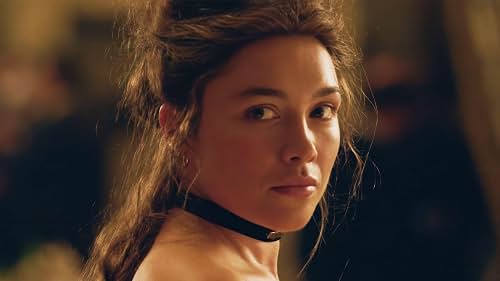
More than seventy years after Elia Kazan turned East of Eden into one of the films that helped build the legend of James Dean, John Steinbeck’s novel is returning to the screen. This time, the story will be told as a seven-episode Netflix limited series premiering on October 1, 2026, with Florence Pugh taking center stage as Cathy Ames. The adaptation was created, written, and executive produced by Zoe Kazan – the granddaughter of the director of the 1955 film.
And that family connection is more than an interesting detail. Elia Kazan adapted only a relatively small portion of Steinbeck’s enormous novel, focusing on the later generation of the Trask family and on Cal. Zoe Kazan herself has acknowledged that the new version takes a very different approach, using its seven episodes to explore a much larger part of the saga.
This Time, Cathy Ames Takes Center Stage
The biggest change is even more interesting. Florence Pugh will not simply be part of the ensemble. The new adaptation places particular emphasis on Cathy Ames – one of Steinbeck’s darkest and most controversial characters. In the novel, Cathy is often portrayed almost as the embodiment of evil. She is beautiful, manipulative, largely without moral restraint, and leaves destruction behind her even before her life intersects with the brothers Adam and Charles Trask.
But Zoe Kazan clearly does not want to leave her solely in that role: “I wanted to make sure that she was also a person and not just an archetype.” Kazan has emphasized that the goal is not to invent a “new” Cathy who contradicts Steinbeck, but to expand on what is already present in the novel – her motivations, her past, and her inner life.
And this may prove to be one of the most interesting differences between the two adaptations. In 1955, the focus was Cal Trask. In 2026, we begin much earlier – with the woman who changes the fate of the entire family.
Cain and Abel in the Salinas Valley
East of Eden was published in 1952 and is both a family saga and a modern retelling of the biblical stories of Adam and Eve and Cain and Abel. The novel spans several generations and follows the intertwined lives of the Trask and Hamilton families in California’s Salinas Valley. The story begins around the time of the American Civil War and continues through the First World War.
Within the Trask family, the biblical pattern repeats itself from one generation to the next. First come Adam and Charles – two brothers who could hardly be more different. Adam is sensitive and gentler, while Charles carries far more anger within him. Their relationship is shaped by rivalry, jealousy, and a painful need for their father’s approval.
Then the story repeats itself with Adam’s sons, Cal and Aron. Again, two brothers. Again, their father’s love. Again, the question of why one seems “good” while the other fears that perhaps evil can be inherited. It is precisely these parallels with Cain and Abel that turn the family drama into something much larger – a novel about free will and whether we are doomed to repeat the history of those who came before us.
“Timshel” – Thou Mayest
And perhaps this is where the true heart of East of Eden lies. Not in the question of who is good and who is evil, but in choice. One word gradually takes on enormous significance in the novel: timshel. In Steinbeck’s interpretation, it means approximately “thou mayest” – not “thou shalt,” not “thou must,” but the possibility that a person can choose whether to overcome evil.
It is the idea that transforms the story of Cain and Abel from a sentence into a choice: our origins, our parents, our mistakes, and our inheritance may shape us, but they do not necessarily determine who we will become. And the new series appears to place the same idea at its center – or, more precisely in Cathy’s case, raises an even more uncomfortable question:
If choice is possible for everyone, what does it mean when someone consciously chooses evil?
Netflix’s official presentation of the series describes the choice between good and evil as one of the adaptation’s central themes, while the trailer again suggests that our future is not ultimately determined by our past.
That is precisely what makes Cathy such an intriguing choice for the new focus. If East of Eden really is a novel about the possibility of choice, what do we do with a character whom the text so often presents as though she were born without a conscience?
From James Dean to Florence Pugh
The 1955 film remains one of the best-known adaptations of Steinbeck’s work. Elia Kazan cast the then relatively unknown James Dean as Cal Trask, and the performance helped turn him into one of the defining figures of American cinema. The film received four Academy Award nominations – for James Dean, Kazan’s direction, Paul Osborn’s screenplay, and Jo Van Fleet’s supporting performance.
Van Fleet won the Oscar for her portrayal of Cathy. Now the role passes to Florence Pugh, surrounded by a strong Netflix ensemble. Christopher Abbott plays Adam Trask, Mike Faist is Charles, Joseph Zada takes on the role of Cal, and Joe Anders plays Aron. Ciarán Hinds appears as Samuel Hamilton, while Hoon Lee plays Lee – one of the characters through whom Steinbeck develops many of the novel’s philosophical ideas.
Join the community
Your library starts here
Every book leaves a mark.
Create your profile and turn what you read into your personal library.