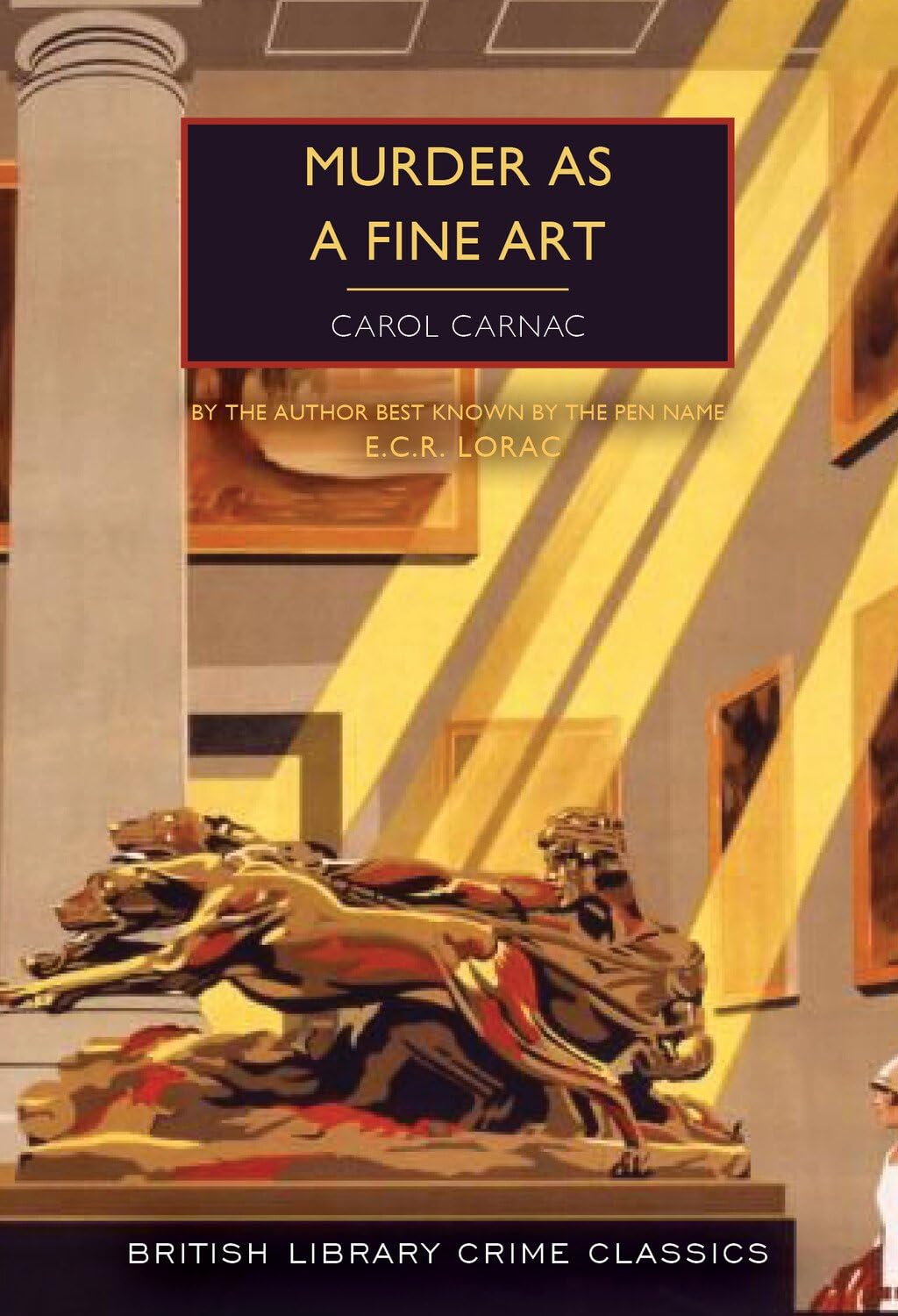

I often write about marketing and books in my reviews and articles, trying to separate genuinely good titles from the advertising noise, but sometimes I fall into that trap too. Murder as a Fine Art by Carol Carnac is one of those books that leaves you realizing, by the end, that you would have lost almost nothing if you had stopped reading halfway through.
The synopsis promises a classic murder mystery: a killing has taken place in the newly established Ministry of Fine Arts. The victim is senior official Edwin Pomfret, crushed beneath a marble bust. With suspicions of corruption inside the department and a relatively small circle of suspects, you naturally expect a genuine Golden Age-style mystery.
In fact, that is exactly what the cover promises. The reality could hardly be further from it. Carol Carnac wrote under two different pseudonyms and published more than 70 novels in total. She was also a member of the Detection Club alongside Agatha Christie and Dorothy L. Sayers. With a background like that, my expectations naturally rose. I imagined discovering an author of Christie’s calibre, someone capable of keeping me guessing until the final page.
Murder as a Fine Art is part of Carnac’s Inspector Julian Rivers series – her own Poirot, if you like. Unfortunately, he turned out to be remarkably bland, deeply uninteresting, and far from impressive in his deductions about the murderer. He faded into the background just as much as the equally flat supporting characters and main suspects. And now, two weeks after finishing the novel, I am not even sure I remember exactly who the killer turned out to be.
One of the weakest aspects of the book for me, however, was the dialogue. In a crime novel with a limited pool of suspects, dialogue should be one of the author’s main weapons – building character, creating suspicion, and quietly dropping clues. Here, it mostly slows down an already sluggish plot. The first part of the novel, before the murder takes place, is devoted to explaining how easily works of art can be forged and how difficult those forgeries can be to detect – a point that is then repeated again in unnecessarily long passages.
Rivers’ interrogations lack any real tension or momentum, while some of the conversations between characters became so indistinct that at times I genuinely forgot who was even present in the scene.
The BOOKLOVERS rating is 2 out of 5 stars. The sheer disappointment of this book could probably have been avoided if I had simply read the Goodreads reviews first. At least I now know that there is something worse than a crime novel with a predictable killer: a crime novel where, two weeks later, you cannot even remember who the killer was.
If you have already finished the book, I would be very curious to hear what you thought of it.
Join the community
Your library starts here
Every book leaves a mark.
Create your profile and turn what you read into your personal library.
Follow us on social media: