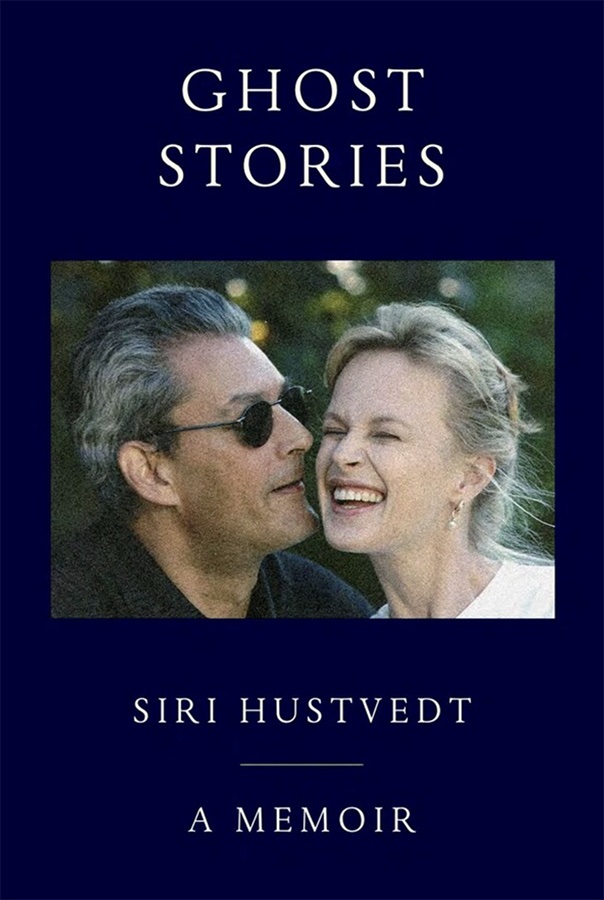

How do you continue living after the death of the person with whom you shared your everyday life for more than four decades? In Ghost Stories, Siri Hustvedt does not search for an easy answer. In what may be her most intimate book to date, she returns to the forty-three years she spent with writer Paul Auster—to love, literature, family life, small daily rituals, and the tragedies they endured together.
But this is not simply a memoir about a celebrated writer. It is a book about what remains of two people when one of them is no longer there.
Forty-Three Years of Conversation
Hustvedt and Auster spent almost their entire life together in dialogue. They read each other’s work, edited one another, argued, and talked about literature, politics, art, and everything else that gradually creates the private language of a long relationship.
After Auster’s death in 2024, that conversation suddenly became one-sided. And perhaps that is why Ghost Stories feels, in part, like an attempt to keep it going.
Hustvedt includes entries from her own journals, messages, and letters, but also personal writings by Auster that had never previously been published – notes and letters to her, as well as the final book he began writing shortly before his death.
Letters to Miles was addressed to his grandson Miles, who had been born only a few months before Auster died. He managed to complete thirty-five pages.
“My impulse to put the 35 pages that Paul was able to finish of what he thought could be a small book into my book was also to preserve our family, but also the dialogue that Paul and I had for 43 years together.”
Auster was writing to a child who was not yet able to read, almost as though he were leaving letters not only for Miles, but for the future. It is more than an unfinished manuscript. It becomes a final attempt by a grandfather to tell his grandson who he was, where his family came from, and what he hoped might remain of him.
When Grief Changes Time
Hustvedt never describes grief merely as an emotion. For her, it alters the way a person experiences time, space, and even the body itself. Auster’s belongings remain in the house. His letters. Manuscripts. Pens. Smells. Habits. The places where he used to sit. After forty-three years of intimacy, absence does not simply feel like an empty space. Paradoxically, it becomes a presence.
And this is where the title Ghost Stories begins to mean something much more profound. Before his death, Auster himself had said that he wanted to live on as a ghost. Hustvedt recalls:
“And on the day we buried Paul at a small funeral in Green-Wood Cemetery in Brooklyn, there was a small after-burial event here at the house. And at one point, I just left and went upstairs into our bedroom, and I had a remarkable experience. I felt Paul’s presence coming up the stairs and walking into the bedroom, looking at me to make sure I was all right. And I was filled with joy, and then he left. Now, presences, it turns out, are not unusual in grieving people. I was joyous. It was a great thing.”
And when she is asked whether the closer we are to someone, the harder it becomes to live without them, her answer is simple: “I think it’s true. You know, if a human being has the capacity for love, that person is going to grieve. And the more powerful those feelings, the greater the intimacy, I think, the more profound the grief.”
The Tragedy That Could Not Be Left Out
The final years of Hustvedt and Auster’s life together were marked by more than his illness. Before that, the family endured two devastating losses – the death of their granddaughter Ruby and the subsequent overdose death of Auster’s son Daniel. Hustvedt does not avoid this story in Ghost Stories, despite the complicated and painful relationship between father and son.
“I knew it would be deeply dishonest not to include that story because Paul loved his son.”
But she adds something equally important: she did not want that tragedy to overwhelm the entire book. And that decision says a great deal about Ghost Stories itself. Because a human life is rarely only one thing. Even during the darkest years there is laughter, absurdity, irritation, ordinary routines, and stories that can still make people smile decades after they happened.
Paul Auster and the Beef Commercial
One of the most unexpected stories in the book is almost comic. At a time when Auster was already a well-known writer, he was offered a considerable amount of money to appear in a Japanese television commercial promoting American beef. The family was far from wealthy, and the money was significant.
Hustvedt, however, already knew her husband would never accept. “I think his integrity was too ferocious. He wasn’t going to smile about American beef in Japan.”
When Writing Becomes a Way of Preserving Someone
Ghost Stories is part memoir, part philosophical exploration of grief, memory, language, and identity. But perhaps above all, it is an attempt to preserve another human being through words.
Auster remains present in his own letters, in the unfinished pages written for Miles, in the notes he left behind, but also in the way Hustvedt continues to think. Paul Auster wanted to return as a ghost.
In Siri Hustvedt’s book, in some sense, he does. Not as a shadowy figure from another world, but through words, letters, stories, laughter, and the memory of the woman who shared his life.
And perhaps that is the only form of immortality literature can truly promise.
PAUL AUSTER IN BRIEF
Paul Auster (1947–2024) was one of the most recognizable American writers of his generation—a novelist, essayist, poet, translator, screenwriter, and filmmaker.
He achieved international recognition with The New York Trilogy, while some of his best-known works also include Moon Palace, The Music of Chance, and 4 3 2 1. Auster also wrote the screenplay for the cult 1995 film Smoke.
His work repeatedly returns to questions of chance, identity, solitude, memory, and the strange ways in which a human life can be transformed by a single moment.
Join the community
Your library starts here
Every book leaves a mark.
Create your profile and turn what you read into your personal library.
Follow us on social media: