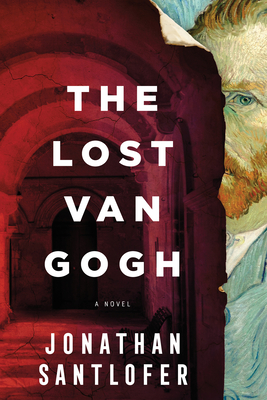
What if one of Vincent van Gogh’s final self-portraits was never truly lost, but simply hidden beneath another painting?
That question lies at the heart of The Lost Van Gogh by Jonathan Santlofer, a historical thriller that brings together a real mystery from the artist’s life, the Nazi looting of European art, and the modern underground market for stolen masterpieces.
When Alexis Verde buys an old painting from an antique shop, she has no idea that something far more valuable may be concealed beneath its peeling surface. Her friend Luke Perrone, an artist and art expert, discovers traces of another work beneath the visible image. A self-portrait. And not just any self-portrait, but what may be a lost painting by Vincent van Gogh, missing since shortly after his death.
A mystery that began with a real letter
The idea for the novel grew out of a genuine historical document. After Van Gogh’s death, his friend and fellow artist Émile Bernard described the funeral in a letter. Van Gogh’s body was laid out in the room where he had lived, surrounded by yellow flowers and several of his final paintings.
Among the works on display, Bernard mentions a self-portrait that cannot be identified with certainty today. This led Santlofer to ask: Had Bernard simply made a mistake? Or was an unknown self-portrait really present at the funeral, only to disappear afterwards? That small gap in the historical record became the foundation of the entire mystery.
A painting lost between war and greed
The discovery takes Luke and Alexis back to one of the darkest periods in European history. During the Second World War, the Nazi regime condemned much of modern art as “degenerate.” Thousands of works were confiscated from museums, galleries, and private collections, while countless Jewish families were forced to surrender their property.
Some paintings were destroyed. Others were sold. Still others found their way into the private collections of senior Nazi figures such as Hermann Göring.
In the novel, the possible Van Gogh self-portrait passes through occupied Paris and the galleries of the Jeu de Paume, where the Nazis stored and distributed stolen works of art.
Members of the French Resistance take a desperate risk to save the painting. Decades later, however, the past still has its guardians—people willing to kill to prevent the true history of the canvas from being revealed.
When every painting carries the history of a human life
The Lost Van Gogh does not use the Second World War merely as dramatic scenery. At the centre of the novel is the still-urgent question of art restitution: the return of works stolen or acquired under coercion during the Nazi era to their rightful owners and heirs.
Behind every painting stands more than the name of the artist. There is also the story of the person who once owned it. A family forced to flee its home. A collection scattered across different countries. A life erased from official records. The search for the self-portrait therefore becomes more than a hunt for a priceless work of art. It is also an attempt to restore a stolen history.
An author who understands the world of forgers
Jonathan Santlofer does not write about art as an outsider. He is an artist himself and has spent years combining visual art with fiction. He also creates what he calls “legal forgeries”—copies of famous works that are never presented as originals and are not intended to deceive.
That experience gives him unusual insight into the psychology of forgers, thieves, and dealers in illicit art. To make this world convincing, Santlofer explores how artists imitate another painter’s technique, artificially age canvases, reproduce signatures, and layer paint so that a work appears to have been created decades or even centuries earlier.
His experience as a visual artist is also present throughout the plot—in the way the characters study colour, brushwork, the surface of the canvas, and the tiny imperfections that may ultimately reveal the truth.
What can every creative person learn from Van Gogh?
For Santlofer, Van Gogh is not only a tragic figure or a legendary painter. He is an example of the persistence without which creativity cannot survive. When asked what anyone who creates can learn from Van Gogh, Santlofer replied:
“Van Gogh gives us many lessons. First, to find what you love and stick with it. He failed at being a pastor, like his father, and an art dealer like his brother, Theo. He was not a natural, facile draftsman, and he struggled to get things down on paper and canvas, and in so doing created a new way of seeing, a new idea and vision of painting and drawing.
Once he realized that being an artist was all he wanted, he did not let anyone tell him he could not do it or was not good enough—and many did. Though his self-doubt was often strong, so was his commitment.
I love this quote: ‘If you hear a voice within you say “you cannot paint,” then by all means paint, and that voice will be silenced.’
And he worked harder than anyone. In his last seventy days of life, in Auvers-sur-Oise, he made seventy-five paintings—more than one a day.
He was just being recognized when he died. Articles that praised his fierce, uncompromising artwork were being written about him. Had he lived a few more years, he would have seen enormous success.”
A thriller between history and the art market
The Lost Van Gogh brings together several mysteries. Is the painting genuine? Where has it been for more than a century? Who has owned it? Who has the moral and legal right to possess it?
And what is truth worth in a world where works of art are traded like currency? Santlofer follows the path of the canvas from Van Gogh’s final days through Nazi-occupied Europe and into the modern world of auction houses, museums, and the shadowy spaces of the illegal art market.
The historical mystery and the criminal plot unfold side by side in a world where beauty often exists alongside greed, and where the value of a single painting can be reason enough for someone to erase the traces of the past.
More than the search for a lost masterpiece
The Lost Van Gogh is a thriller about a possible painting, but also about the stories preserved within works of art. About the masterpieces taken from the people who loved them. About secrets concealed beneath layers of paint. About the line between copy and original, ownership and theft, beauty and crime.
And about an artist who knew almost no success during his lifetime, yet continues to inspire obsession, controversy, and mystery more than a century after his death. Sometimes a lost painting is not merely a work of art the world cannot find. It is a story someone is desperately trying to keep hidden.
Join the community
Your library starts here
Every book leaves a mark.
Create your profile and turn what you read into your personal library.
Follow us on social media: