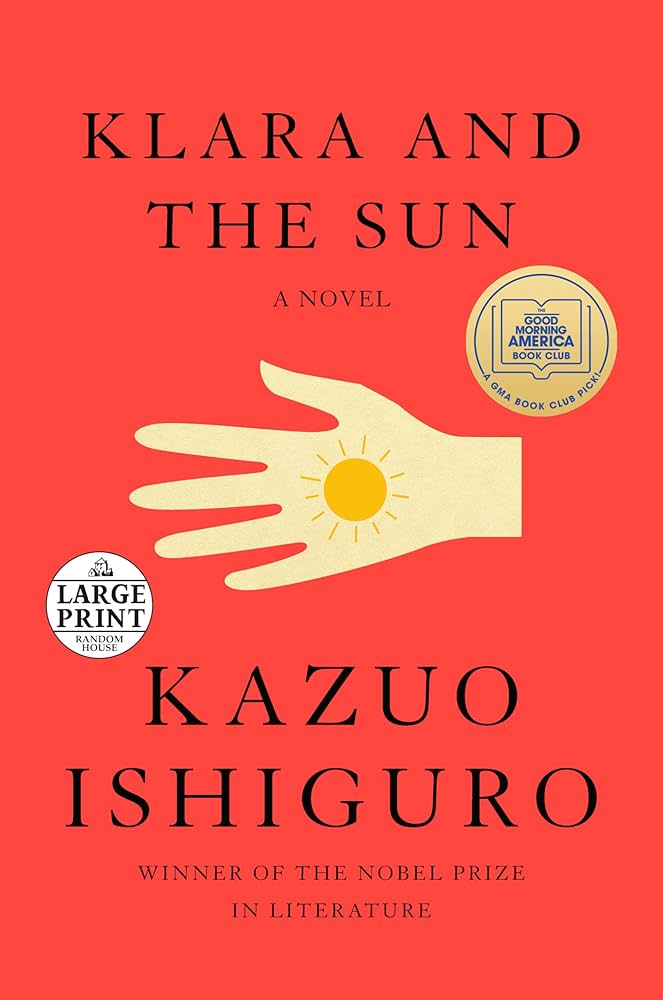

Klara and the Sun by Kazuo Ishiguro is one of those rare literary treasures that stays with you far more strongly after you finish it than while you are actually reading it.
At its heart lies one enormous question—one that has the power to shift the entire way we think about humanity:
Is there something uniquely human that can never be copied?
The novel is set in the near future, where Ishiguro imagines a dystopian society in which children undergo genetic enhancement in order to improve their chances of success. At the same time, Artificial Friends have been created—companions purchased by parents for children who seem increasingly unable to form real friendships of their own.
And this is where Klara enters the story.
She is an Artificial Friend who spends the first weeks of her existence in a store, observing both the other models and the people passing by. To Klara, the shop is an entire universe. She takes nothing for granted.
Powered by solar energy, she gradually develops a belief—almost a kind of faith—that the Sun possesses healing powers, that it is an all-powerful and merciful being.
Klara is chosen by the family of Josie, a seriously ill girl, because of her extraordinary ability to notice and remember even the smallest details. From that moment on, Klara turns helping Josie recover into the central purpose of her existence, regardless of the price she may have to pay.
And that becomes one of the novel’s most striking paradoxes.
Klara never asks whether the sacrifice is worth it.
For her, self-sacrifice is not a decision. It is the most natural expression of love. She does not fear for herself. She wants only one thing—for Josie to live.
Ishiguro also creates several secondary storylines through which he explores consciousness, devotion, love, human selfishness, cynicism, and the difficult question of what goodness truly means.
Some of these ideas are only suggested, woven quietly into the lives of characters inhabiting a world that is never fully explained. Klara’s world is not described down to the final detail, but I don’t believe that is because Ishiguro was unable to build it more completely.
The novel was never really about the future.
It is about us.
What gives Klara and the Sun its power is not the dystopian setting, but the philosophy and moral questions beneath it.
Klara is almost childlike—naive, devoted, and pure of heart despite not possessing a human soul in the conventional sense. And that is perhaps the greatest irony of all: the machine becomes the most human character in the entire novel.
If you are looking for a book that will make you think, one that reframes one of humanity’s oldest questions in a completely new way, Klara and the Sun is exactly that kind of novel.
BOOKLOVERS Rating: 5/5
Klara and the Sun does not ask whether artificial intelligence can become human.
It asks whether we truly understand what it means to be human ourselves.
And that is precisely why the novel remains with you long after the final page.
Join the community
Your library starts here
Every book leaves a mark.
Create your profile and turn what you read into your personal library.
Follow us on social media: