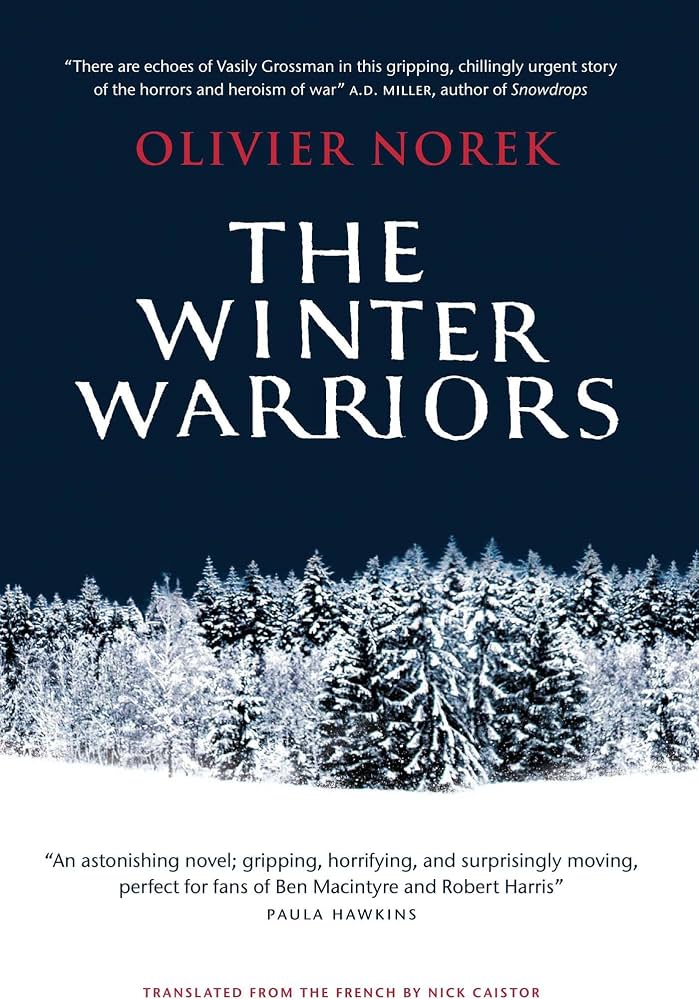
Olivier Norek’s The Winter Warriors follows one of the most fascinating military conflicts in modern history – a moment when a vast army crossed the border of a much smaller neighboring country expecting its resistance to collapse almost immediately.
The war was supposed to be short. It wasn’t. On November 30, 1939, the Soviet Union invaded Finland. Facing the Red Army was a country of only around four million people, with a significantly smaller military and limited resources. Yet the expected rapid victory turned into 105 days of fighting under some of the harshest winter conditions of the twentieth century.
Finland was ultimately forced to surrender territory, but it preserved its independence. This is the war Olivier Norek turns into a novel. The story follows real participants in the conflict, with Finnish farmer and sniper Simo Häyhä, the man who became known as the “White Death”, at its center. But Norek is not interested only in the legend. The more important question is how ordinary people become soldiers when someone crosses their border.
Before the First Shot Comes the Pretext
The war did not begin in a vacuum. In August 1939, Germany and the Soviet Union signed the Molotov–Ribbentrop Pact, whose secret protocol placed Finland within the Soviet sphere of interest. Moscow demanded that the border be moved farther away from Leningrad, along with territorial concessions and military positions.
Finland rejected some of those demands. Then came Mainila. On November 26, the Soviet side announced that Finnish artillery had shelled the Soviet village of Mainila, causing casualties. Finland denied responsibility and proposed a joint investigation.
Only days later, the Soviet Union renounced the non-aggression pact and launched its offensive on November 30. Later archival evidence and Russian acknowledgments confirmed that the shelling had originated from the Soviet side and that the incident had been used as a pretext for invasion. That historical context inevitably changes the way the novel is read today. And Norek’s own interest in the war began with a very contemporary fear.
From a Putin Statement to Finland in 1939
Norek has explained that the idea began to take shape after he heard Vladimir Putin refer to Russia’s nuclear arsenal against the backdrop of Western support for Ukraine. His first reaction was fear. Instead of remaining inside that fear, he decided to investigate the history behind it.
“Not so long ago I was in the south of France and heard Vladimir Putin’s voice on the radio. He was kindly reminding us that he had nuclear weapons and that he wouldn’t hesitate to use them if we supported Ukraine. It scared me but I knew that fear was fed by ignorance, so I wanted to find out more about Russia’s relations with the rest of the world in the last century. That’s when I learned about this forgotten war that took place over 105 days in minus 51C weather. I also discovered the name of Simo Häyhä, who was apparently the best sniper of all time. I knew that I had the ingredients for an incredible story.”
And so a crime writer found himself in very different territory. He was no longer investigating a crime. He was investigating a war.
To Write About Minus 40, You Have to Understand What Minus 40 Means
Norek is a former police officer, and he describes his approach rather aptly: he was a “field cop” and now likes to think of himself as a field author.
So archival research was not enough. He traveled to Finland in winter. “It helped me to understand that the Finnish soldiers were in an impossible situation. When the temperature drops to minus 40C, you become paralysed. The cold doesn’t just make you shake – it attacks you. You can’t protect yourself, you can’t think. And yet the Finns were able to come up with strategies and stay in the snow to fight for hours without moving.”
Norek wanted to understand even the smallest physical details. He obtained the same type of rifle used by Finnish soldiers and went into the forest to practise shooting with it. He even tried the alcohol the soldiers drank in the cold. Not because every detail necessarily had to appear in the novel, but because he wanted his body, even briefly, to understand something documents could never fully explain. And that may be why the cold in the novel is not merely background. It is an enemy.
Simo Häyhä: The Man Behind the “White Death”
Häyhä’s story hardly needs fictional embellishment. Before the war, he was a farmer and hunter. After the Soviet invasion, he went to the front and gradually became one of the most famous snipers in military history.
For Finns, his status has long since become legendary. For Norek, however, the task was to find the man beyond the legend. “For Finnish people, Häyhä is on the level of Napoleon Bonaparte or Joan of Arc – very, very famous. So everybody has a story to tell about him. I worked with soldiers, veterans and snipers and found his diary. I spent two and a half years with my feet in the snow, trying to get as close to his character as possible. He wasn’t just a legend – Häyhä was a myth.”
Norek was particularly fascinated by Häyhä’s ability to remain motionless in extreme cold and hit targets at extraordinary distances. But perhaps the most revealing detail came much later. When Häyhä was around 80 years old, a German journalist asked whether he considered himself a hero. His answer was simple: he had only done what he had to do, just like the other Finnish soldiers around him.
That is precisely what Norek says he admired about him. Häyhä was not a murderer by nature. He was a farmer defending his country.
How Much of The Winter Warriors Is Actually History?
This is where the novel becomes particularly interesting. Norek makes clear from the beginning that many of the conversations are drawn from archives, testimony, military sources, and discussions with historians. He also maintains that the battle scenes and acts of courage described in the novel have a documentary basis.
Independent reviews largely support the impression of a novel that stays unusually close to the historical record. The Historical Novel Society has described it almost as a fictionalized military history, in which most of the characters and events are real, while another of its reviewers praised Norek’s ability to turn historical documentation into a tense narrative. But there is an interesting gap between what historians appreciate and what some readers notice.
When History Begins to Weigh Down the Novel
The more strictly a writer follows the documents, the less freedom remains for the novelist. And some critics can feel that tension.
A review in the Winnipeg Free Press notes that Norek’s determination to include as much historical information as possible occasionally produces conversations that sound more like explanations directed at the reader than natural dialogue.
The Saturday Paper raises a similar concern about scenes away from the immediate battlefield, where certain characters seem to exist primarily to deliver historical context. Other readers find some of the characterization too clearly divided between heroic Finns and incompetent Soviet forces. That may ultimately become one of the most interesting questions surrounding the novel: Can a novel remain as faithful as possible to the documents without allowing history to suffocate the fiction?
A War Without a Beautiful Victory
And this is exactly where it becomes important not to turn the story into a simple legend about David defeating Goliath. Finland did not win the Winter War in the conventional sense. After heavy losses and a renewed Soviet offensive, it signed a peace treaty and surrendered significant territory. Hundreds of thousands of Finns were forced to leave their homes.
The Soviet Union achieved part of its territorial objectives – but at an enormous cost. That makes The Winter Warriors more than the story of a legendary sniper. The war was supposed to end in days. But someone forgot to ask the Finns – a people prepared to do whatever it took to defend their homeland.
Join the community
Your library starts here
Every book leaves a mark.
Create your profile and turn what you read into your personal library.
Follow us on social media: