
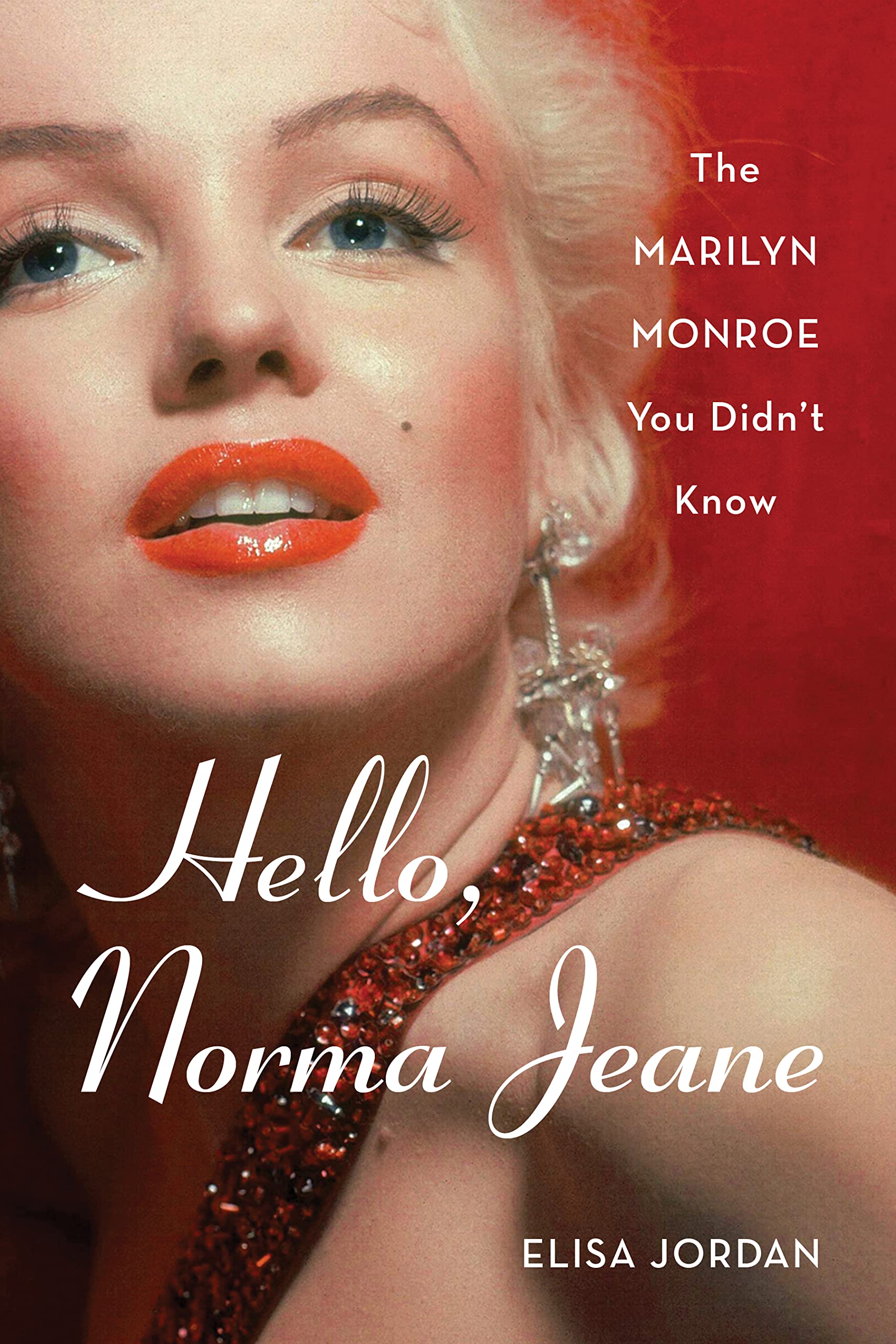
Hello, Norma Jeane, Elisa Jordan
Marilyn Monroe is one of those rare figures almost everyone knows something about. The white dress above the subway grate. The platinum-blonde hair. “Happy Birthday, Mr. President.” Joe DiMaggio. Arthur Miller. Hollywood. Scandals. Theories surrounding her death.
The problem is that the more recognizable the image of Marilyn Monroe becomes, the easier it is for Norma Jeane to disappear behind it. It is precisely Norma Jeane whom Elisa Jordan attempts to recover in Hello, Norma Jeane: The Marilyn Monroe You Didn’t Know – a book that does not follow the traditional biographical model year by year, but instead divides the actress’s life and personality into individual themes: childhood, career, love affairs, homes, food, books, fame and, inevitably, her death.
The original edition contains 44 thematically organized chapters and is conceived as an accessible, fact-based counterpoint to the decades of rumors and mythology surrounding Monroe.
Before Marilyn, There Was Norma Jeane
Norma Jeane Mortenson was born in Los Angeles in 1926. Her childhood had almost nothing in common with the glamour that would later define her public image. The identity of her father remained uncertain, her mother Gladys suffered from serious mental health problems, and Norma Jeane spent years moving between foster homes and institutions.
At sixteen, she married James Dougherty, largely as a way to avoid returning to foster care after the family she was living with had to leave California. During the Second World War, she worked in a factory, where in 1945 she was noticed by photographer David Conover, who had been sent to photograph women involved in wartime production. Modeling followed, then her first magazine covers and a contract with 20th Century Fox. And Norma Jeane gradually became Marilyn Monroe.
From the “Pretty Girl” to One of Hollywood’s Greatest Stars
Success did not come overnight. Her roles in The Asphalt Jungle and All About Eve brought her wider attention, and over the following decade Monroe became one of the most recognizable actresses in the world. My personal favorite from her filmography is undoubtedly Some Like It Hot. For the role, she won a Golden Globe for Best Actress in a Comedy or Musical in 1960.
And the idea that her acting talent received virtually no recognition is not entirely accurate either: she won three Golden Globes and received four nominations in total. But one problem remained behind all that success. Hollywood was in love with the image of Marilyn. Marilyn herself wanted to be taken seriously as an actress. And those two things did not always coincide.
Marilyn, the Reader
This is where Hello, Norma Jeane becomes more interesting than a conventional biography. Elisa Jordan does not simply ask when Monroe made a particular film or whom she married. She asks what she liked to eat, what she read, how she saw her own body, what she wanted to learn, what her everyday life looked like beyond the photographs.
In other words, Jordan steps outside the familiar “dumb blonde” stereotype – an image Monroe herself transformed into an extraordinarily profitable screen persona. In reality, her personal library contained more than 400 books spanning literature, poetry, psychology, philosophy, religion, politics and science.
Among the writers she returned to were James Joyce, Walt Whitman, Dostoevsky, Tolstoy and Rilke. Some of her books survive with her annotations and underlining, showing that they were hardly decorative objects in a Hollywood star’s home. Yes, Marilyn definitely had another side.
Love, Marriage and a Woman Turned Into a Story
Marilyn married three times. First James Dougherty, then baseball legend Joe DiMaggio, and finally playwright Arthur Miller. Over time, however, so much mythology accumulated around her love life that separating documented history from gossip became increasingly difficult.
Perhaps the clearest example is her alleged relationship with John F. Kennedy. The firmly established historical fact is her famous performance of “Happy Birthday” for the president in May 1962. Beyond that, biographers disagree. Some believe the two probably had a brief intimate encounter; others emphasize that there is no evidence of a prolonged romantic relationship. Claims about a relationship with Robert Kennedy are even less firmly supported.
And this is exactly where a book like this becomes valuable. Not because it can remove the mystery surrounding Marilyn. But because it can separate what we actually know from what has simply been repeated for so long that it has begun to sound like fact.
The Marilyn Monroe We Don’t Know
Elisa Jordan has been immersed in this story for a long time. She is a journalist, editor and Los Angeles historian who has studied Monroe’s life since childhood, after first seeing Gentlemen Prefer Blondes. She also leads themed tours of Los Angeles and co-hosts a podcast devoted to Marilyn. That is why Hello, Norma Jeane does not simply attempt to add yet another version to the enormous library of books about Monroe. Instead, it takes apart the version we already think we know.
Marilyn Monroe died in August 1962 at just 36 years old. More than six decades later, her face continues to sell posters, T-shirts, cosmetics, films, documentaries and new biographies. And perhaps that is the paradox. Marilyn never disappeared. Norma Jeane did – far more often. Because the legend is easy to tell. A beautiful girl with a difficult childhood becomes the most desired woman in the world, loves famous men and dies young and tragically. The real person is far messier, ambitious, curious, insecure, well read, sometimes difficult.
Marilyn was a woman capable of using her own sexuality as a professional weapon while simultaneously resenting the limitations of the image it created. And perhaps that is exactly why we continue to read about her. Not because we do not know the story. But because, for far too long, we have mostly known the legend.
Стани част от общността
Твоята библиотека започва тук
Всяка книга оставя следа.
Създай профил и превърни прочетеното в твоя лична библиотека.
Последвайте ни в социалните мрежи: