What would happen if, one morning, an entire country simply lost all contact with the rest of the world? Not for a few hours. Not because of a temporary technical failure. Forever.
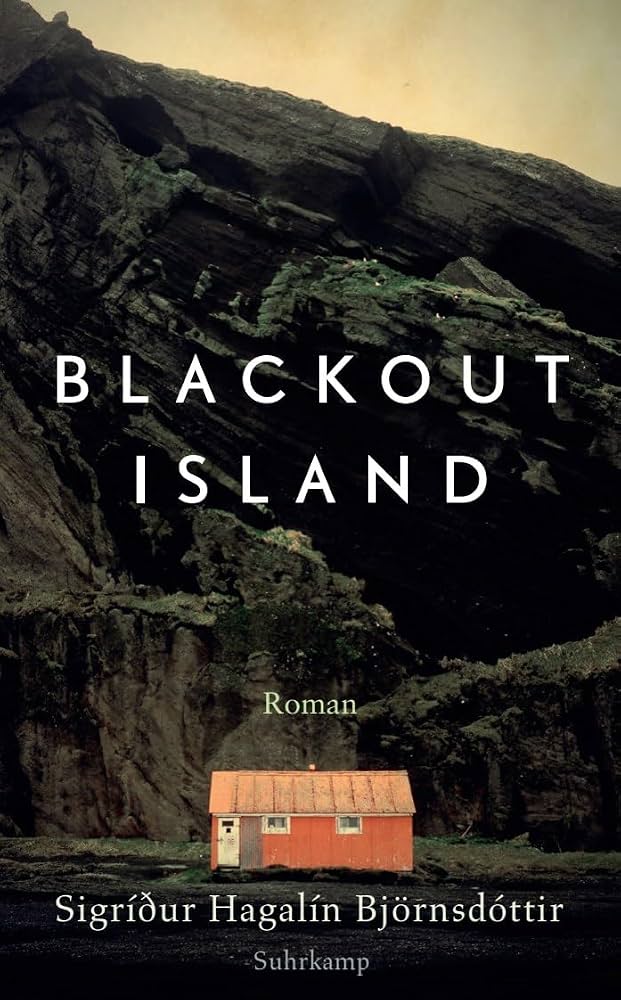
In Blackout Island (Eyland), Icelandic writer and journalist Sigridur Hagalin Bjornsdottir turns that question into a social and political experiment. One morning, Iceland wakes up completely isolated. Undersea communication cables have gone dead. Planes stop arriving. Ships never come. No one knows what has happened to the rest of the world. At first, society tries to maintain order, then fuel begins to run out, medicine. food.
And gradually it becomes clear that many of the things we take for granted – government, institutions, money, freedom of movement, access to information, even trust between people – function only as long as the system around them continues to work. The novel was first published in Iceland in 2016. A decade later, it may feel even more relevant than it did then. Perhaps that is also why the story is now heading for the screen.
How Quickly Can Democracy Become Something Else?
Blackout Island is an apocalyptic novel, but the catastrophe itself is never really its central concern. Bjornsdottir is interested in what happens afterwards. What happens to a society when security disappears? Who do we blame? Who do we trust? Who gets access to increasingly scarce resources? And how long does it take before fear turns a neighbour into a threat?
The story unfolds through several characters occupying very different positions in society, including an influential journalist and a single immigrant mother. Their experiences gradually reveal different faces of the same crisis.
Because hunger and fear do not merely destroy an economic system. They begin to reshape the very idea of who belongs to society — and who does not. The media, political power, crisis communication, and nationalism become increasingly important, until the question “Who is one of us?” begins to determine who can be sacrificed.
Ten years after the novel’s publication, Bjornsdottir admits that rereading her debut can still shock her. “I’m always a little shocked when I reread parts of it – it seems very raw and rough to me now, brutal, even.” And yet she believes that rawness belongs to the story. “Although I think I would write a very different novel today, I think its raw, desperate energy fits the subject, and I hope it still manages to describe how easy it is for a civilised democracy to slip into chaos and fascism.”
A Novel That Burst Out Like a Howl
The idea for Blackout Island stayed with Bjornsdottir for more than fifteen years. For much of that time, she expected someone else to write it. The premise seemed almost too obvious: a small island nation, deeply dependent on its connections with the outside world, suddenly left entirely on its own. Eventually, she realised the story was hers to tell.
“I carried the idea with me for more than 15 years and always waited for someone else to write that book – it seemed such an obvious idea – but in the end I realised that the story had picked me, and that it was my job to write it.”
After carrying the idea for fifteen years, the actual writing took only three months. “I had no control over the process; the story burst out of me like a howl.” The result was Eyland, her debut novel, which became a bestseller in Iceland and earned Bjornsdottir a nomination for one of the country’s literary awards for women’s writing.
Before Brexit. Before Trump. Before Covid
Today, Bjornsdottir has another reason to look differently at the book she wrote a decade ago. When she was working on Blackout Island, the world had not yet experienced many of the events that would shake Western societies’ sense of stability over the following years.
“Now I find it uncannily prescient – I wrote it before Brexit, before Trump, before Covid-19, and most of the events that have rattled our sense of security in the last few years.” And this is where the novel begins to feel strangely prophetic.
Not because Bjornsdottir predicted one particular catastrophe. She anticipated the response- information uncertaint, fear, isolation, the search for someone to blame, populism, the division between “us” and “them” and the gradual willingness to exchange freedoms and moral principles for the promise of security.
The Journalist Who Loves Catastrophes
It is probably no coincidence that a novel like this was written by a journalist. Before becoming one of the recognizable voices in contemporary Icelandic literature, Bjornsdottir spent years working as a television journalist and presenter for Iceland’s national public broadcaster, RÚV.
And when asked why she repeatedly returns to catastrophe – societal collapse in Eyland, volcanic disaster in The Fires, political power struggles in medieval Iceland explored elsewhere in her work – her first response is considerably less gloomy than you might expect: “Well, you should see me in the kitchen! Catastrophes are my speciality.”
Behind the joke, however, lies a much more serious idea. “But I’m a news reporter at heart, and fascinated by events that change the course of history and warp our sense of reality.” For Bjornsdottir, crises reveal who we are with a clarity that ordinary life rarely can. Under normal circumstances, it is easy to believe that we would make the right choice.
But what happens when that choice carries a real cost? “Deep down inside, are you material for a cruel despot, an obedient minion, or a selfless hero? There’s no way to tell until you’re in a situation where you’re faced with difficult life-or-death choices.”
And that, she argues, is precisely why we need books that force us to consider those choices before we ever have to make them.
Not an Apocalypse, but a Political Experiment
Blackout Island could easily be described as a survival novel. But that would tell only half the story. Because Sigridur Hagalin Bjornsdottir’s real question is not what people will eat when the food runs out. It is what happens to democracy when fear becomes stronger than principle. What happens to the media when reliable information disappears. What happens to tolerance when there are no longer enough resources for everyone. And what happens to our understanding of ourselves when circumstances force us to choose between our own survival and somebody else’s life.
Join the community
Your library starts here
Every book leaves a mark.
Create your profile and turn what you read into your personal library.
Follow us on social media: