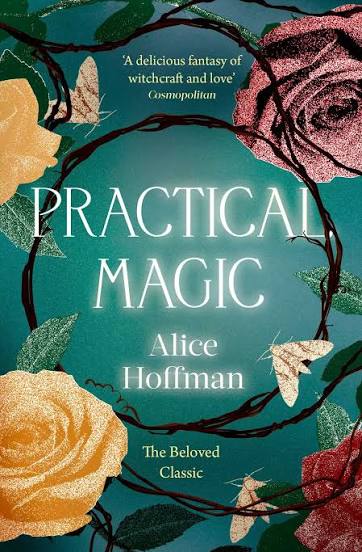
Practical Magic, Alice Hoffman
For more than two hundred years, the women of the Owens family have been blamed for every misfortune that befalls their small Massachusetts town. Sally and Gillian grow up as outsiders. Other children avoid them, mock them, and whisper about their family, while their eccentric aunts do little to discourage the rumors—with their old house, strange concoctions, black cats, and long-standing reputation for witchcraft.
The sisters themselves want only one thing. To be normal. Both try to escape their inheritance, but in very different ways. One seeks security in marriage and family; the other simply runs away. Years later, however, a tragic event brings them together again and reminds them that the bond between them has always been the greatest source of strength in their lives.
Alice Hoffman’s Practical Magic, first published in 1995, became the inspiration for the beloved 1998 film starring Sandra Bullock and Nicole Kidman. But readers who know the Owens sisters only from the screen may be surprised by the novel itself.
The Darker Side of the Owens Family
The film adaptation transforms the story into a memorable blend of romance, dark humor, magic, and the cozy autumn atmosphere that has helped Practical Magic become a multigenerational favorite. Hoffman’s novel is darker.
The magic is still there, but beneath it lies a story about sisterhood, roots, inherited memory, social rejection, and love—not as the romantic reward waiting at the end of a fairy tale, but as one of the most powerful forces capable of transforming a human life. At its heart, Practical Magic is less concerned with whether witches exist than with what it means to grow up believing that there is something about you the rest of the world will never accept.
For Alice Hoffman, Magic Has Never Been Just a Plot Device
Interestingly, Hoffman does not treat magic in her novels as a genre trick. She has never been particularly comfortable with the label “magical realism,” explaining instead that her writing is rooted much more deeply in the traditions of fairy tales, mythology, and folklore—the stories she grew up reading.
As she once explained:
“I don’t purposely pursue magic—it’s just part of the prose that I write.”
For Hoffman, magic is not so much about what happens in a story as it is about the way that story is told. Perhaps that is why Practical Magic never becomes simply a novel about witches. Magic is the language through which Hoffman explores something much more human: love and loss, belonging and rejection, family inheritance, and the parts of ourselves we may spend years trying to escape.
Four Books and Generations of Owens Women
Practical Magic was published in 1995, but the story of the Owens family did not end there. More than two decades later, Hoffman returned to their world and gradually transformed it into a four-book family saga spanning generations.
The Rules of Magic goes back to the previous generation and tells the story of Franny, Jet, and Vincent Owens. Magic Lessons travels even further into the past, to the seventeenth century and Maria Owens—the woman at the beginning of the family legend and the curse that will follow generations of Owens women. The final novel, The Book of Magic, brings different generations of the family together again and completes the story.
Hoffman even leaves readers with two possible ways to experience the series. In publication order:
Practical Magic → The Rules of Magic → Magic Lessons → The Book of Magic
Or chronologically through the Owens family history:
Magic Lessons → The Rules of Magic → Practical Magic → The Book of Magic
What begins as the story of two sisters eventually becomes a family saga stretching across centuries.
More Than the Author of Practical Magic
Although Alice Hoffman’s name will forever be associated with the Owens family for many readers, her body of work extends far beyond Practical Magic. She is the author of more than thirty works of fiction and has frequently woven historical events into her novels.
The Dovekeepers takes readers to the ancient fortress of Masada. The Marriage of Opposites explores the life of the mother of painter Camille Pissarro, while The World That We Knew is set in France during the Holocaust. Whether she is writing historical fiction or telling the story of a family of witches in Massachusetts, Hoffman repeatedly returns to similar themes—memory, loss, family, love, and the ways people survive what life asks them to endure.
Sandra Bullock and Nicole Kidman Return as the Owens Sisters
Nearly three decades after the first film, Sandra Bullock and Nicole Kidman are returning as Sally and Gillian Owens in Practical Magic 2. The sequel draws inspiration from the final novel in the series, The Book of Magic, bringing the story back to several generations of the Owens family.
Dianne Wiest and Stockard Channing are also returning as Aunt Jet and Aunt Franny, while Joey King and Maisie Williams join the cast.
The film is scheduled for release on September 11, 2026. Almost thirty years after audiences first met Sally and Gillian Owens, it seems the magic is far from over.
Join the community
Your library starts here
Every book leaves a mark.
Create your profile and turn what you read into your personal library.
Follow us on social media: